
A damaged or altered drain line often needs more than a replacement tee: the failed section must be cut back to sound, round pipe, the new branch must preserve the invert and fall, and every joint must be prepared for service. By the end, you will know how to measure the existing line, select the right fabricated tee, install it without creating a blockage, and maintain the repaired layout.
Key takeaways
- Cut back to sound, round pipe before fitting the replacement tee.
- Match tee dimensions and branch geometry to the existing drainage layout.
- Expose straight pipe for correctly sized couplings or repair sleeves.
- Test flow and inspect joints before covering the repaired drainage run.
How a fabricated tee restores a damaged drainage run
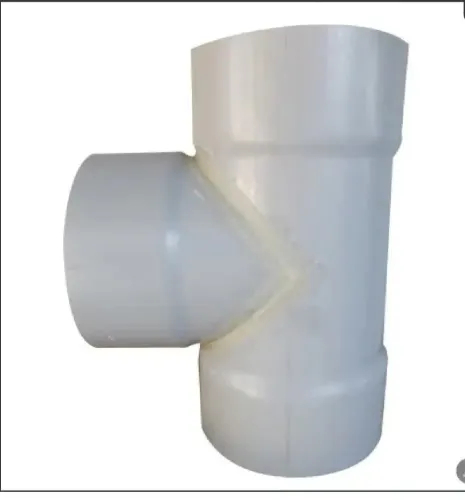
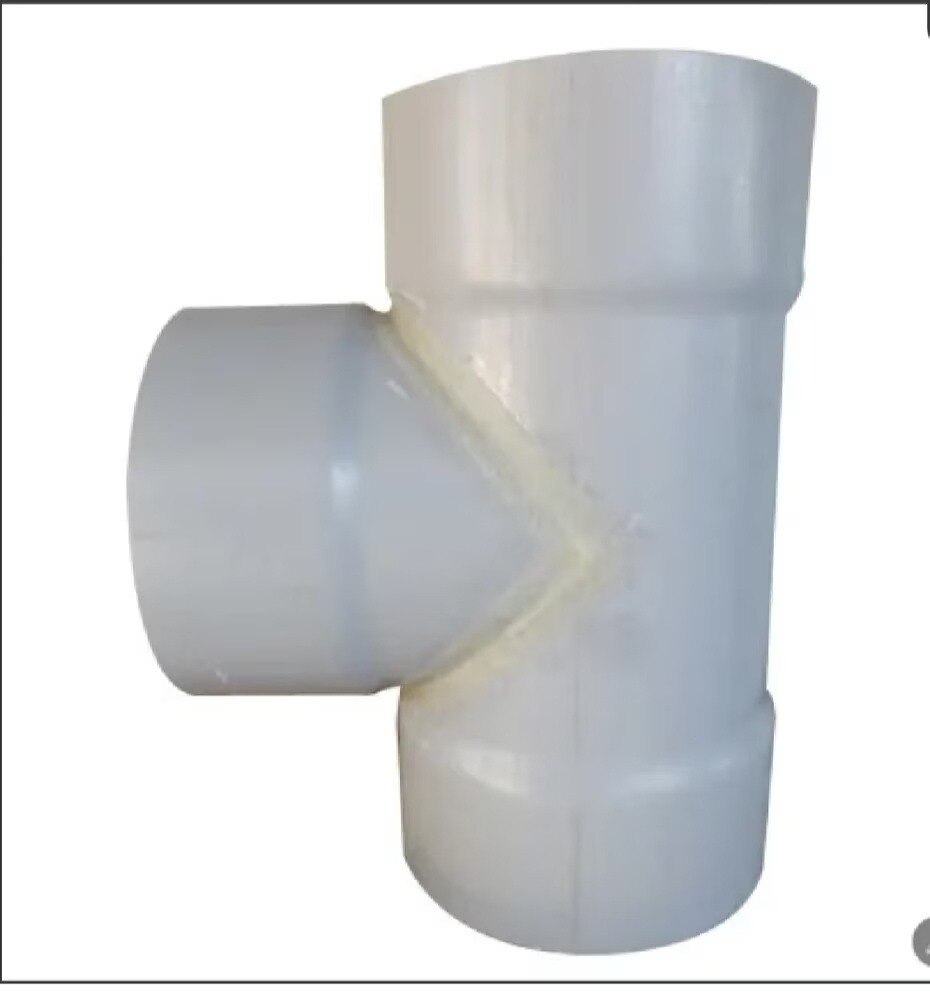
A PVC fabricated tee reconnects a drainage layout by replacing the failed section and adding a correctly aligned branch at the same time. Cut the damaged pipe back to sound, round material, then expose enough straight pipe on both sides for properly sized couplings or repair sleeves.
A pvc tee repair fitting cannot seal over cracked, flattened, or distorted pipe; leaving the defect underneath simply hides the failure.
- Cut out the damaged length and remove burrs without reducing the pipe’s outside diameter.
- Dry-fit the fabricated tee, couplings, and branch pipe before applying cement. Check that the main run keeps its slope, the branch points in the required direction, and the assembly fits the available clearance.
- Mark insertion depths and alignment lines on every joint, then clean and prepare the mating surfaces according to the cement manufacturer’s instructions.
- Solvent-weld the joints in sequence, holding each connection against rotation while it sets. Keep cement and debris out of the bore.
- Support the repaired run before testing so settlement does not load the new joints.
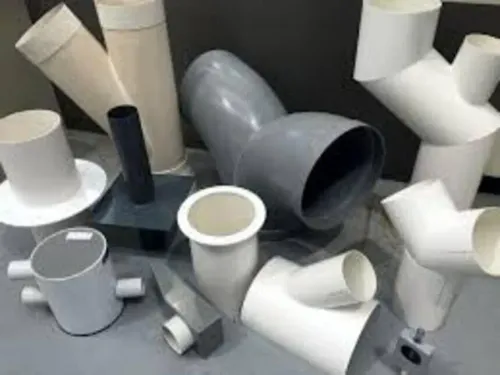
The pvc fabricated tee benefits for drainage repairs include a non-stock branch diameter, unusual angle, or short custom spool that a standard injection-moulded tee cannot provide. It remains a site-fabricated component, not automatically equivalent to a moulded fitting or compliant with ASTM D2665; confirm its dimensions, materials, construction, and required test before approval.
A saddle branch or coupler-and-tee assembly may suit a different access constraint.
Choose the tee by dimensions, branch geometry, and service
Compare the tee with the existing system before approving a pvc fabricated tee drainage repair. Match the pipe outside diameter, nominal diameter, wall thickness, socket depth, branch diameter, and branch angle; a nominal 100 mm label alone does not prove that the sockets will fit.
| Option | Dimensional and joint characteristics | When it applies |
|---|---|---|
| PVC fabricated tee | Cut pipe sections joined by solvent-welded joints; dimensions and angles are custom, with more potential leak paths | Non-stock branch sizes, unusual angles, or a short custom spool |
| Injection-moulded PVC tee | Factory-formed geometry and consistent sockets; limited to available sizes and angles | Standard drainage layout with matching stock dimensions |
| PVC tee repair fitting | Repairs a local branch connection but does not replace cracked or distorted pipe | Only after cutting back to sound, round pipe |
| Saddle branch | Branch attaches to the outside of an intact main, without cutting in a full tee | A suitable branch can be added where access and system design permit |
Confirm whether the line carries foul sewage, stormwater, building drainage, or industrial effluent. Also identify whether it is a non-pressure drain or a pressure service; a drain fitting is not automatically suitable for pressurised flow.
Ask for the pipe grade, wall thickness, branch dimensions, socket depth, solvent-welding method, and evidence of a water or leak test. ASTM D2665 covers PVC drain, waste and vent pipe and fittings, but PVC raw material alone does not make a fabricated tee compliant.
Record the branch angle, invert level, installation clearance, and the required authority or project test; older Chhatrapati Sambhajinagar drawings may name the city Aurangabad.
Check the existing pipe before ordering or approving the repair
Confirm a PVC tee repair fitting against the actual pipe, not the nominal size written on an old drawing. Measure the outside diameter with calipers or a tape, identify the wall series and pipe standard, and check whether the connection is plain-ended or socketed.
Record these details before fabrication or approval:
- Identify the service: foul sewer, stormwater, building drainage, or an industrial line. Confirm whether the drawing uses Chhatrapati Sambhajinagar or the older name Aurangabad, then check the authority’s required test.
- Measure the run and branch diameters, branch angle, invert level, available socket depth, and clearance for cutting, joining, and future access.
- Inspect the adjacent pipe. Cut the damaged section back to sound, round material; a tee fitted over cracked, flattened, or distorted pipe leaves the failure in place.
- Check line and level, bedding, settlement, pipe deflection, and above-ground branch supports. A sound tee will fail again if movement or poor support remains.
- Confirm the proposed component’s construction, dimensions, material, and test documentation. ASTM D2665 covers PVC drain, waste and vent pipe and fittings, but PVC raw material alone does not make a custom-fabricated tee compliant.
Reject a tee repair when the pipe cannot be exposed far enough to obtain straight, stable ends, when the branch cannot maintain the required slope, or when the service demands pressure performance the fabricated component was not designed and tested to provide. A short custom spool or coupler arrangement may suit the site better.
Install and test the tee without creating a hidden leak or obstruction
A reliable PVC fabricated tee drainage repair begins with enough straight pipe exposed on both sides of the cut. Remove the failed section, keep the trench clean, and confirm that the remaining pipe is sound rather than forcing a joint onto cracked or ovalised ends.
1. Cut squarely and remove burrs, swarf, mud, and standing water. The branch must meet the main at its specified angle, with its inside edge clear of the invert and the intended fall.
2. Dry-fit the tee and couplers before applying cement. Check socket depth, branch direction, clearance for tools, and alignment with the downstream run. Mark insertion depth and orientation on every pipe end; a rotated tee can redirect flow or leave a projecting branch inside the bore.
3. Prepare each mating surface using the pipe and solvent-cement manufacturer’s method. Apply primer where the system requires it, then spread compatible cement evenly without leaving a thick internal bead.
4. Push each joint fully home with a firm quarter-turn, hold it briefly, and wipe away external excess. Do not clamp the tee so rigidly that thermal movement loads the new joints; support the branch and allow movement as the installation requires.
5. Keep the assembly undisturbed for the cement’s stated cure time, then test with the project’s gravity-drainage water or leakage test. Inspect every fabricated joint while water passes through, and confirm that no silt-catching lip, cement ridge, or slow-draining branch remains.
Maintain the repaired branch and document its location
Inspect the repaired branch after commissioning, then at each scheduled drainage inspection. Look for staining, seepage, distortion, branch movement, loss of slope, and joint misalignment; also check the adjacent pipe, bedding, supports, and line level because settlement often causes failure before PVC deterioration does.
- Confirm the run and branch remain aligned.
- Check buried sections for settlement, exposed damage, or ground disturbance.
- Flush or jet only within the fitting manufacturer’s pressure and nozzle limits.
- Avoid aggressive rodding that can catch an internal joint lip or damage a projecting custom branch.
- Protect an above-ground branch from unsupported loading and rigid clamps that transfer thermal movement into solvent-welded joints.
Cover partly exposed PVC against prolonged sunlight and impact. Follow the project specification for burial depth, warning tape, protection sleeves, or a suitable coating; later excavation and construction traffic can crack a shallow tee.
Record the asset while the trench is open: project location, drawing reference, pipe outside diameter, wall series, invert level, branch angle, joint date, installer, batch or fabrication reference, photographs, and test result. Label the record as Chhatrapati Sambhajinagar, and cross-reference “Aurangabad” if older drawings use that name.
For a PVC tee in Chhatrapati Sambhajinagar, give Swapnil Enterprises these verified dimensions and the foul sewer, stormwater, building-drainage, or industrial service before fabrication. That prevents a replacement based on the wrong authority requirement or pipe system.
Related products
 | PVC FABRICATED TEE Our PVC Fabricated Tee is a high-quality, durable solution for various plumbing and construction needs. View product → |
 | Fabricated PVC Fittings Fabricated PVC fittings are custom-shaped fittings, often for larger diameters, made by cutting, bonding, and thermoforming segments of existing PVC... View product → |
Frequently asked questions
How does a fabricated tee restore a damaged drainage run?
It replaces the failed pipe section while adding a correctly aligned branch. Cut the damaged pipe back to sound, round material and expose enough straight pipe for properly sized couplings or repair sleeves.
How do you choose a PVC fabricated tee for drainage repairs?
Match the tee to the existing pipe dimensions, branch geometry, and drainage service. Confirm the branch direction, connection method, and available installation space before ordering.
What should you check before ordering a PVC tee repair fitting?
Inspect the existing pipe for its outside diameter, wall condition, roundness, alignment, and usable straight length. Remove damaged material from your measurement so the replacement fits sound pipe.
How do you install and test a fabricated PVC tee?
Align the tee with the existing run and branch, use correctly sized couplings or repair sleeves, then test flow and inspect every joint before concealing the repair.
How should you maintain and document a repaired PVC tee?
Keep the branch accessible for inspection, watch for settlement or recurring blockage, and record its location, branch direction, pipe dimensions, and repair date.
Related product
 | Fabricated UPVC Fittings Fabricated UPVC fittings are custom-made, non-standard pipe connection components, often larger than 12 inches in diameter, constructed by joining... View product → |