
A quotation that says only “UPVC long bend” leaves critical questions unanswered: size, radius, joint type, pressure service, included accessories, and documentation. By the end, you will know how to define the fitting, check pipe compatibility, and require the supplier to state every included and excluded item before you approve the order.
Key takeaways
- Confirm the order includes the bend, markings, and protective packaging.
- Put size, angle, radius, connection, pressure rating, and material on the quotation.
- Ask for drawings, test records, batch details, and commercial terms.
- Check the bend socket or spigot against the pipe before installation.
What should a standard UPVC long bend order include?
The answer to what comes with upvc long bend order is usually limited to the moulded or fabricated bend, its product identification markings, and ordinary protective packaging. Pipe, joining materials, supports, and labour are not included because a product name does not define the full supply scope.
| Item | Normally included | List separately |
|---|---|---|
| UPVC long bend | Moulded or fabricated fitting in the agreed size and configuration | State whether it is catalogue, fabricated, or segmented |
| Identification | Size, angle, batch or manufacturer marking applied to the fitting | Request additional inspection or traceability documents |
| Packaging | Normal protective wrapping, cartons, or pallets | Specify special packing or export packing |
| Accessories | None unless quoted | Pipe, couplers, reducers, solvent cement, primer, cleaner, rubber rings, threaded adapters, clamps, and supports |
| Site work | None | Installation labour, excavation, bedding, backfill, and alignment |
Request an itemized quotation that marks every accessory as included, excluded, or available at an additional charge. These are essential upvc long bend purchase details, not optional wording.
For an elastomeric-ring joint, require the seal material, joint system, and ring status: factory-installed, supplied loose, or excluded. Ring compatibility matters in wastewater, oil-contaminated environments, and chemical service; UPVC alone does not prove complete-joint compatibility.
The quotation should also state pieces per carton, carton dimensions, pallet quantity, gross weight, freight terms, price basis per piece, carton, or pallet, and whether packaging is returnable or disposable.
Which UPVC long bend specifications belong on the quotation?
Put every dimension and rating into the UPVC long bend quotation before you compare prices. “100 mm” or “4 inch” is incomplete: the number might mean nominal bore, nominal outside diameter, or a manufacturer’s designation, and those are not automatically interchangeable.
Ask the supplier to confirm these UPVC long bend specifications:
- Nominal size, pipe outside diameter, dimensional system, bend angle, centerline radius or sweep, and center-to-face dimensions
- Wall thickness or pressure designation, socket insertion depth, socket inside diameter, and spigot outside diameter
- End squareness, permitted dimensional tolerances, connection type, and whether the bend is moulded or fabricated
- Applicable product standard and drawing reference
| Service | State these details | Do not assume |
|---|---|---|
| Pressure piping | PN, SDR, or pressure class, plus the temperature basis for that rating and the fitting standard | A matching pipe diameter gives the bend the pipe’s pressure rating |
| Drainage | Outside diameter, socket geometry, angle, radius, wall dimensions, and the applicable drainage standard | A PN rating is needed or proven without pressure-service evidence |
Identify the standard for the intended system and market, such as ISO 1452, EN 1329, EN 1401, EN 1452, IS requirements, or ASTM D2665. ASTM D2665 addresses PVC drain, waste, and vent fittings; it does not establish suitability for pressurized service.
State whether the ends are solvent-weld sockets, plain spigots, elastomeric-seal sockets, threaded ends, or a combination. Without the dimensional system, pipe outside diameter, and tolerance limits, a low price can still describe the wrong fitting.
How do you choose the angle, radius, connection, and service type?
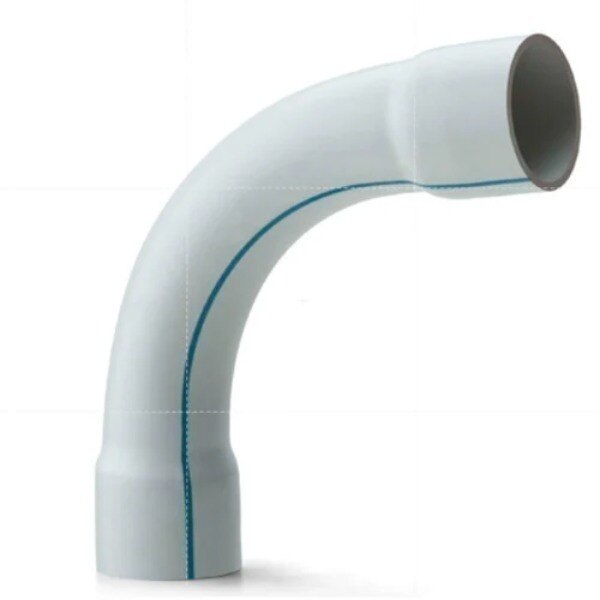
Choose the angle and radius from the route, then record them in the UPVC long bend specifications. A 45-degree or 90-degree long-radius bend turns flow more gradually than a short elbow, but its larger sweep needs more center-to-face and route space. Approve the supplier’s dimensional drawing against the installation layout before ordering.
| Configuration | Geometry | Space and order implication |
|---|---|---|
| 45° long-radius bend | Gradual direction change over a smaller angle | Requires more route length than a short elbow; state the radius and center-to-face dimension |
| 90° long-radius bend | Gradual quarter-turn | Uses more center-to-face space than a short 90° elbow; verify clearances and supports |
| Short elbow | Tighter direction change | Saves space but creates a sharper turn; do not substitute it because the nominal size matches |
State the connection precisely: solvent-weld sockets, plain spigots, elastomeric-seal sockets, threaded ends, or a combination. “Socketed” is incomplete because a ring-groove socket is not a solvent-weld socket; specify the seal material and whether rings are factory-installed, loose, or excluded.
Record these as UPVC long bend purchase details, including whether the part is a moulded one-piece fitting or a fabricated or segmented bend. Use a moulded fitting for documented catalogue geometry; request fabrication for large diameters, unusual angles, or non-standard centerline dimensions. Identify pressure piping, soil-waste-rainwater drainage, buried sewer, chemical service, or another system.
The quotation must state matching pressure, temperature, fluid-compatibility, and installation limits, since bedding, backfill, and joint protection are not automatically supplied.
What documents and commercial details should a UPVC long bend supplier provide?
A complete upvc long bend quotation and order confirmation must define the product, evidence, and commercial terms—not only a unit price.
1. Identify the requested compound or material designation, color, manufacturing process, applicable ISO, EN, IS, or ASTM standard, approved drawing revision, marking method, batch-traceability method, and dimensional tolerances. State PN, SDR, or pressure class with its temperature basis for pressure service.
2. Request the documents that match the project: dimensional drawing, certificate of conformity, batch or lot identification, inspection report, and pressure, leakage, or other test results. “UPVC long bend” alone proves neither certification nor pressure rating.
3. For a customized or fabricated bend, separate the fitting price from tooling or mould charges, drawing approval, sample or first-article approval, dimensional inspection, minimum order quantity, and manufacturing lead time. State which costs are included.
4. Record stock status, delivery coverage, freight terms, price basis per piece, carton, or pallet, pack quantity, carton dimensions, pallet quantity, gross weight, and whether packaging is disposable or returnable.
Use these questions with an upvc long bend supplier such as Swapnil Enterprises when comparing offers in Chhatrapati Sambhajinagar. Ask the supplier to identify every accessory and document as included or excluded; pipe, seals, cement, adapters, supports, and installation work do not become part of the order by implication.
Related product
 | UPVC LONG BEND Our UPVC Long Bend is a premium, durable solution for smoothly redirecting pipe flow over extended angles. View product → |
How should you check the bend against the pipe before installation?
Catch a mismatch before cutting pipe. For reliable UPVC long bend purchase details, compare the delivered fitting with the approved drawing and the actual pipe, not just the size printed on the carton.
- Measure the pipe’s actual outside diameter with a caliper. If access is limited, measure its circumference and divide by 3.142, then compare that result with the fitting drawing.
- Confirm that the pipe series or SDR matches the bend’s socket geometry and pressure designation. A matching nominal size does not prove that the wall thickness or pressure class is compatible.
- Measure socket depth. The pipe must reach the specified stop without bottoming out or leaving an excessive gap.
- Check the socket inside diameter, spigot outside diameter, bend angle, centerline radius, center-to-face dimensions, end squareness, and stated tolerances against the approved drawing.
Joint type changes the assembly method:
| Joint type | What to verify | What goes wrong if mismatched |
|---|---|---|
| Solvent-weld socket | Pipe, primer, cleaner, and cement compatibility | A seal may fail if treated as a push-fit joint |
| Elastomeric-ring socket | Correct ring size, material, groove, and insertion depth | The joint can leak or displace the ring |
| Threaded end | Specified mating adapter and thread form | The pipe cannot connect safely without the adapter |
Before installation, check the marking, batch number, quantity, carton condition, supplied rings, and accompanying documents. Record shortages or dimensional discrepancies immediately. Bedding, supports, backfill, and route changes are project installation matters, not automatic parts of what comes with UPVC long bend order.
Frequently asked questions
What should a standard UPVC long bend order include?
A standard order usually includes the moulded or fabricated bend, product identification markings, and ordinary protective packaging. Pipe, joining materials, supports, and labour require separate confirmation.
Which UPVC long bend specifications belong on the quotation?
List the nominal size, outside diameter, bend angle, centreline radius, connection type, pressure or service class, material, quantity, colour, applicable standard, and any inspection requirements.
How do you choose the angle, radius, connection, and service type?
Choose the angle from the route change, the radius from space and flow requirements, the connection to match the pipe joining method, and the service type from pressure, temperature, fluid, and installation conditions.
What documents should a UPVC long bend supplier provide?
Request a quotation, technical data sheet, dimensional drawing, material or batch identification, applicable conformity or test records, packing details, delivery terms, warranty terms, and any inspection documents agreed in writing.
How should you check the bend against the pipe before installation?
Compare the marked nominal size and outside diameter, inspect the socket or spigot, measure insertion depth, check the seal or thread arrangement, and dry-fit the bend without forcing it.