
A leaking or repeatedly blocked SWR line does not always have a defective fitting: the cause may be a failed solvent-weld joint, poor gradient, settlement, trapped air, loose supports or a downstream drain restriction. By checking the fitting, pipe geometry and drainage conditions in sequence, you can decide whether cleaning, a local repair, a cut-out replacement or a complete redesign is justified.
Key takeaways
- Classify the fault as a joint, geometry, or wider system defect.
- Check insertion depth, cement coverage, pipe movement, and flow conditions before cutting.
- Replace cracked fitting walls; clean and reseal only intact joints.
- Record outside diameter, socket depth, angles, branches, and access constraints before ordering.
How to tell a fabricated fitting fault from a drainage-system fault
Start by classifying fabricated swr fitting problems in pune as a joint defect, a geometry defect or a wider system defect. A joint leak appears at the solvent-welded socket; if it appears only while water flows, inspect insertion depth, cement coverage and movement. A cracked or split wall is a fitting failure.
1. Treat distorted sockets, poor alignment, an incorrect branch angle or an obstructed bore as geometry defects. They cause local leakage, slow drainage or repeated blockages even when the pipe downstream is clear. Water standing in a low section points to inadequate slope or sagging, not automatically to a bad fitting.
2. Test the line in sections. If flow backs up before the fitting, investigate a blocked downstream pipe, trapped air or a municipal drain that cannot accept discharge. Settlement can change the gradient, while loose supports allow joints to move and reopen.
3. Trace symptoms before replacing parts. An overflow during rainfall points to restricted rainwater capacity, a blocked outlet, inadequate fall or municipal surcharge. Odour often comes from a dry trap or failed vent rather than the fitting itself; a fitting becomes the suspect when the smell follows a visible crack, open joint or displaced connection.
Expose and dry the area, run a controlled discharge from upstream, and mark the first leak or ponding point. That evidence separates a defective fabricated section from a system fault and prevents replacing a sound fitting for a drainage problem.
A practical inspection sequence before you cut out the fitting
Do not cut out a fabricated SWR fitting until you can show whether the failure is in the joint, the fitting geometry, or the surrounding installation. Use the same sequence every time:
1. Isolate the line, empty it completely, and keep upstream fixtures or roof drains closed. Cover nearby fixtures and branches to protect them from solvent vapour, cuttings and debris.
2. Expose the entire fitting and adjoining pipe without forcing the joint. Clean the socket and spigot, then dry both surfaces before inspection; moisture or dirt can hide the actual leak path.
3. Check socket condition, spigot condition, insertion depth and the solvent-weld bead. Look for inadequate pipe insertion, missing deburring or chamfering, wet or contaminated bonding surfaces, insufficient or incompatible solvent cement, movement before cure, and bending stress from misalignment.
4. Inspect the internal bore with a light. Cement ridges, a pipe end projecting into the fitting, an abrupt reducer or an incorrectly angled branch can obstruct flow and cause repeated blockages without an external leak.
5. Measure pipe alignment, support condition and slope. Note sagging, loose supports, settlement and any strain pulling the fitting out of line.
6. Run a controlled water test from the upstream fixture or roof drain. Record the exact leak location, flow condition, photographs and dimensions before dismantling anything.
When cleaning and resealing works—and when repair is only a patch
A local repair is reasonable only when the fitting and socket are intact, the leak is superficial, the joint can be made dry and clean, and no movement is loading it.
That boundary matters in fabricated SWR fitting repair in Pune: silicone, epoxy, repair compounds and external wraps do not restore socket engagement or a continuous solvent-welded connection. Wet, moving or badly aligned uPVC joints will usually leak again.
Cut out the section instead when inspection finds:
- Inadequate insertion, a cracked wall, distorted socket or blocked bore
- An incorrect branch angle, poor gradient or recurrent blockage
- Bending stress, settlement or loose supports that would move the repaired joint
Empty and isolate the line before work. Protect nearby fixtures and branches from solvent vapour, cement and debris, and plan access where walls, shafts or occupied premises restrict cutting and coupling. Keep the exposed pipe dry.
Deburr and chamfer the remaining pipe, install dimensioned couplers or repair couplings, and support the replacement while the solvent cement cures.
Finish with the specified gravity-drainage water test, not a pressure-pipe hydrostatic test. A repair that passes only while temporarily braced is not acceptable. Restore the original slope, support arrangement, clean-out access and venting; otherwise the replacement can preserve the leak while creating slow drainage or another blockage.
How to measure and specify a replacement before ordering
A matching nominal diameter and 45° or 90° angle do not prove a replacement is equivalent. Fabrication can change the internal bore, wall thickness, socket depth and branch geometry, causing poor flow, weak joints or installation failure.
1. Measure the actual pipe outside diameter with calipers; record socket insertion depth, wall condition, centre-to-centre dimensions, bend radius, branch angle and branch diameter. Note orientation, flow direction, available straight length for couplers, access space, support positions and existing slope.
2. Specify the jointing method: solvent cement, rubber ring or another approved system. Identify the material and product class, then require a dimensioned drawing showing outside dimensions, socket and spigot dimensions, bore continuity, tolerances and branch geometry. State whether IS 13592 and IS 14735 apply; non-standard fabricated details need drawing tolerances or project acceptance criteria.
3. Add service conditions to the drawing: indoor or outdoor exposure, UV protection, hot industrial discharge temperature, thermal movement, and restoration of supports or expansion provisions. A fitting that fits cold and dry can distort or leak after heat, sunlight or restrained movement.
4. Define acceptance before ordering: inspect material identification, wall condition, socket depth, bore continuity and joint finish, then perform the project-specified water or low-pressure drainage test. Do not substitute pressure-pipe hydrostatic criteria without engineering approval.
A custom SWR fittings supplier in Pune, including Swapnil Enterprises, is most useful when it requests these measurements before quoting rather than treating every custom part as interchangeable. Use this checklist for any SWR fitting replacement in Pune.
Related products
 | Fabricated SWR Fittings Fabricated SWR (Soil, Waste, Rainwater) fittings are plumbing components, typically made from unplasticized polyvinyl chloride (uPVC), used in... View product → |
 | Fabricated PVC Fittings Fabricated PVC fittings are custom-shaped fittings, often for larger diameters, made by cutting, bonding, and thermoforming segments of existing PVC... View product → |
Choosing between fabricated, moulded, rubber-ring and improvised joints
Choose the joint that fits the installation, not the lowest invoice. Standard injection-moulded SWR fittings suit repeated layouts because their geometry, socket dimensions and inspection are consistent. Fabrication is defensible for unusual offsets, combined branches, tight clearances or angles unavailable in moulded parts.
| Option | Cost and lead time | Dimensional accuracy and flow | Serviceability |
|---|---|---|---|
| Injection-moulded | Usually economical and readily available for standard sizes | Consistent sockets and smoother internal transitions | Straightforward replacement and inspection |
| Fabricated | Higher effort or lead time for a dimensioned custom part | Must verify wall thickness, socket depth, branch geometry and bore continuity | Best for non-standard constraints when documented |
| Rubber-ring | Cost depends on a compatible system and components | Smooth when correctly seated; movement tolerance depends on design | Easier dismantling, but match the pipe, groove and insertion length |
| Improvised site-built | Lowest immediate material cost | Uncertain dimensions, rough transitions and blockage points | Difficult to rod, inspect and replace later |
A fabricated fitting is not equivalent to a moulded one because its diameter and nominal angle match. Confirm the actual outside diameter, material compatibility, socket or spigot dimensions and jointing method before installation.
- Preserve slope, clean-out access, venting and support spacing.
- Inspect the bore, solvent-welded or rubber-ring joints, wall condition and alignment.
- Run the project-specified water or low-pressure drainage test; do not apply pressure-pipe hydrostatic criteria without engineering approval.
Frequently asked questions
How can you distinguish a fabricated fitting fault from a drainage-system fault?
A leak at a solvent-welded socket points to a joint defect, especially when flow exposes poor insertion depth, incomplete cement coverage, or pipe movement. A cracked or split fitting wall indicates a fitting failure. Backflow, repeated blockages, poor gradient, or leaks elsewhere indicate a wider system defect.
What should you inspect before cutting out a fabricated SWR fitting?
Trace the leak while the line is dry and while water flows. Check socket insertion depth, solvent-cement coverage, pipe support, movement, alignment, gradients, blockages, and nearby joints. Photograph and measure the installation before removal.
When can you clean and reseal an SWR joint?
Clean and reseal an intact joint when the fitting and pipe have no cracks, distortion, or movement damage. A reseal is only a patch when the fitting wall is split, the socket is deformed, the pipe cannot be supported, or the system fault remains.
How do you specify an SWR fitting replacement in Pune?
Record pipe outside diameter, socket depth, fitting angles, branch size, centre-to-centre dimensions, wall thickness, installation orientation, access limits, and the required joining method. Send photographs and a marked sketch to a custom SWR fittings supplier in Pune before ordering.
Should you choose fabricated, moulded, rubber-ring, or improvised SWR joints?
Choose fabricated fittings for non-standard dimensions, angles, or branch layouts; moulded fittings for standard shapes and repeatable connections; rubber-ring joints where movement or maintenance access matters. Avoid improvised joints because mismatched geometry, unsupported loads, and incompatible materials create repeat failures.
Related products
 | Fabricated UPVC Fittings Fabricated UPVC fittings are custom-made, non-standard pipe connection components, often larger than 12 inches in diameter, constructed by joining... View product → |
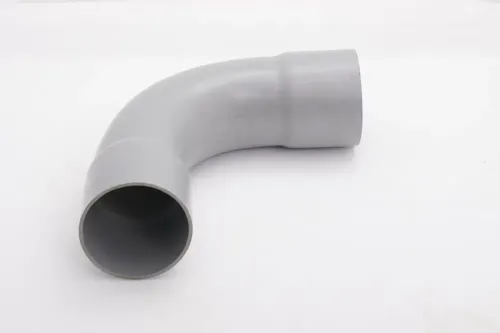
 | PVC FABRICATED LONG ELBOW A PVC fabricated long elbow is a non-standard, custom-molded pipe fitting, often for large diameters, created by heating and bending PVC pipes rather... View product → |
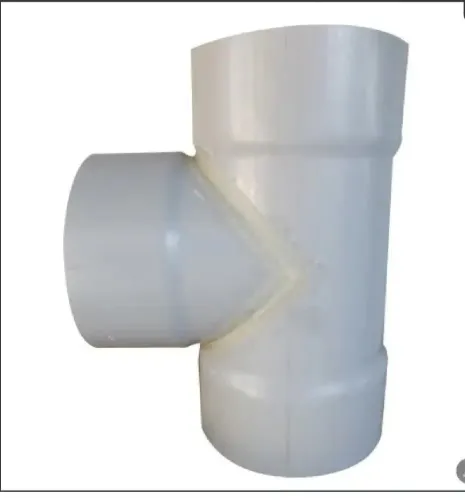
 | PVC FABRICATED TEE Our PVC Fabricated Tee is a high-quality, durable solution for various plumbing and construction needs. View product → |
 | PVC Fabricated Bend Pipe Our PVC Fabricated Bend Pipe is a high-quality, durable solution for various plumbing and construction needs. View product → |