
Slow discharge, gurgling, standing water and repeated backups do not prove that the bend itself has failed. You will learn how to separate a blocked or badly installed bend from a wider drainage fault, choose the right inspection and repair method, and demand records before a buried fitting is replaced.
Key takeaways
- Check the fitting for a reduced bore, lip, sag, or displaced joint.
- Trace flow from the nearest fixture before opening the long bend.
- Replace a deformed or inaccessible bend instead of repeated cleaning.
- Ask Pune contractors for material details, inspection records, and handover photos.
How to tell whether the bend is causing the poor flow
A PVC long bend flow problem is likely only when poor flow begins at that fitting and inspection finds a reduced bore, lip, sag or displaced joint. Slow discharge at one fixture points to a local restriction; backups at several fixtures point farther downstream or to a shared drain.
1. Check the pattern. Gurgling indicates trapped air, poor venting or a partially restricted line. Standing water after discharge indicates a sag, reverse fall or obstruction.
A PVC long bend blockage in Pune that appears only during heavy rain directs attention to monsoon surcharge, terrace or road runoff, inadequate downstream capacity or silt entering an open pipe.
2. Inspect accessible cleanouts and the bend without excavating first. A local lip from solvent-cement squeeze-out, an incompletely cut pipe end, excessive socket penetration or an off-axis joint can catch hair, wipes, grease and sediment.
Roots suggest intrusion through a failed joint; widespread sediment suggests an open or poorly capped pipe; a collapsed section needs camera evidence.
3. Separate partial from complete blockage. Some discharge with recurring backups requires proof of reduced bore by controlled flushing, rodding or CCTV. No discharge usually requires access, controlled rodding, jetting or excavation.
A long bend rarely creates serious pressure-line loss by itself. Check a closed valve, low pump head or undersized pipe first. In gravity drainage, verify slope, bedding and invert levels: a bend installed with a sag, reverse fall or displaced support causes retention even when its diameter is adequate.
The field sequence for diagnosing a long-bend blockage
Start PVC long bend troubleshooting by classifying the line as pressure service or gravity drainage. For a PVC long bend for poor flow in Pune, record affected fixtures, downstream water levels and accessible cleanouts before disturbing the fitting.
- Inspect cleanouts at every change of direction and identify the affected section.
- Measure invert levels and pipe falls with a laser level or suitable level. A pressure test cannot prove that a gravity line drains correctly.
- Check insufficient slope, reverse fall, a bend installed in the wrong orientation, misaligned sockets, excessive socket penetration, an undersized nominal diameter, a rough internal joint and an unapproved angle combination.
- Flush with a controlled volume of water and observe discharge, retention and the downstream level.
- Use a drain rod only when the access point, rod type and direction suit the line. Never force a steel rod through PVC; it can score or crack the bend, dislodge a joint or drive debris deeper.
| Method | Evidence provided | Use |
|---|---|---|
| Controlled flush | Confirms discharge and retained water | Initial flow check |
| Drain rod | Indicates reach and soft blockage resistance | Accessible debris or sediment |
| CCTV | Shows roots, sag, joint lip, collapse or obstruction location | Uncertain defects |
| Water jet | Removes deposits or blockage | Only at pressure suited to pipe, nozzle, hose and condition |
Avoid aggressive jetting through old, cracked or poorly supported PVC. Excavate only after these checks locate a collapsed, displaced or inaccessible defect; record photographs or CCTV and levels first.
When to clean, repair or replace the fitting
Clean a PVC long bend blockage in Pune when inspection shows loose construction debris, silt or grease and the fitting remains sound. Use a controlled flush, a suitable drain rod or jetting selected for the pipe, nozzle and hose; chemical drain cleaners can attack seals, damage PVC, leave hazardous residues and hide a structural defect.
Match the intervention to the evidence:
- Clean it when deposits or debris reduce the bore but the bend is intact.
- Repair it when a local joint defect is accessible and the pipe remains aligned.
- Cut out a cracked, deformed or poorly bonded bend, or one with a displaced rubber ring, then install compatible couplers. Replace the surrounding section if the adjacent pipe has also lost alignment.
A buried bend beneath tiles or concrete costs more time because locating the obstruction, breaking the finished surface, arranging access equipment, managing contaminated water and reinstating the surface all add work. Confirm the fault before excavation.
Compare these choices before authorising replacement:
| Option | Compare by | Best fit |
|---|---|---|
| Long bend | Radius, space, turbulence | Smooth direction change where its radius fits |
| Short-radius elbow | Compactness, turbulence | Tight space with acceptable flow loss |
| Two 45-degree bends | Alignment, joints, access | Gradual offset using standard fittings |
| Fabricated bend | Lead time, cost, dimensions | Special radius or angle |
| Rodding-access fitting | Cleaning access, installation time | Recurring PVC long bend flow problem |
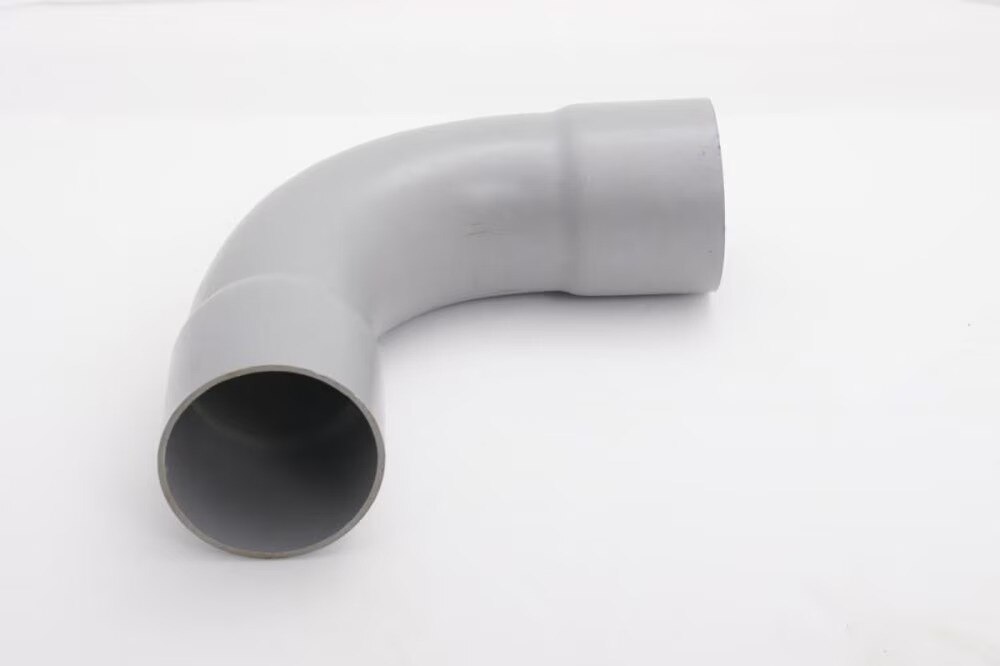
Require a drawing or datasheet: “long” has no standard radius. Check nominal diameter, sockets, angle, wall thickness, service, connection system and temperature or chemical limits. A long bend is wrong when inspection access is essential, its radius cannot fit, or structural movement needs another joint arrangement.
Pune site conditions that change the diagnosis and handover
Pune site conditions can create or conceal a flow fault, so do not blame the bend before checking the surrounding system. Construction debris or monsoon-borne silt entering an unsealed pipe can mimic a fitting defect. Cap every open end during construction and flush the line before commissioning sanitary fixtures.
1. Check whether terrace or road runoff enters the sanitary or drainage line. A downstream connection under monsoon surcharge can make a sound bend appear blocked. Record the condition during dry and wet weather, and inspect for hard-water deposits that narrow the bore.
2. Inspect access before opening finished surfaces. Dense residential and commercial properties can restrict rodding, jetting, camera insertion and excavation, leaving a concealed defect unproved. A PVC long bend for poor flow in Pune needs an obstruction location, not a replacement guess.
3. Measure exposed runs for movement. PVC changes about 0.06–0.08 mm per metre for each 1°C temperature rise; inadequate restraint or expansion allowance can shift a bend joined to rigidly fixed pipework. Provide continuous bedding and support under buried drainage so the bend does not carry the gradient.
4. Remember that smooth PVC, commonly assigned Manning roughness n = 0.009–0.011, still loses capacity when a joint lip or deposit reduces flow area.
5. Before concealment, hand over the route drawing, bend angle and radius, nominal diameter, pre- and post-bend slope or invert readings, joint inspection, flushing record, camera footage where access permits, and a witnessed flow test.
How to compare a PVC long bend contractor in Pune
Choose the PVC long bend contractor in Pune who produces records, not the one who promises to replace the fitting. Before approval, require these details:
| Evidence | What to require | Reject if missing |
|---|---|---|
| Bend specification | Product drawing or datasheet showing radius, material grade, nominal diameter, wall thickness, socket dimensions and angle | “Long bend” is the only description |
| Installation record | Joining method, solvent-cement system or seal type, installation drawing and method for maintaining slope | No invert-level readings before and after the bend |
| Testing plan | Controlled flush, witnessed flow test, CCTV footage where possible, obstruction location and photographs; use a pressure test only for pressurised service | Pressure-test result offered as proof that gravity drainage flows correctly |
Ask the contractor to state the jetting-pressure limit for the pipe, nozzle and hose. Request access points, cleanout locations and the method for checking misalignment, a joint lip, sag or reverse fall before excavation.
Require the quotation to separate the fitting, couplers, excavation, tile or concrete removal, access equipment, flushing, contaminated-water disposal, debris disposal, labour, reinstatement, and night or restricted-access work. Warranty terms must identify coverage for the fitting, joints, workmanship and restored surfaces, plus the evidence required for a claim.
Swapnil Enterprises can be considered for a customised PVC or UPVC fitting when its verified dimensions and application records match the installation. Do not approve “replace the bend” without pre- and post-repair levels, flushing records and a witnessed flow test.
Related products
 | PVC LONG BEND Our PVC Long Bend is a high-quality, durable solution for smoothly redirecting pipe flow over extended angles. View product → |
 | PVC FABRICATED LONG ELBOW A PVC fabricated long elbow is a non-standard, custom-molded pipe fitting, often for large diameters, created by heating and bending PVC pipes rather... View product → |
Frequently asked questions
How can you tell whether a PVC long bend is causing poor flow?
Confirm that poor flow starts at the fitting, then inspect for a reduced bore, lip, sag, displaced joint, or blockage. A single slow fixture indicates a local restriction; several affected fixtures indicate a downstream or shared-drain issue.
What is the field sequence for diagnosing a PVC long-bend blockage?
Start with the affected fixture, compare flow at nearby fixtures, inspect accessible joints, flush or rod the line, and use a camera or test opening when the restriction remains unconfirmed. Record the fitting condition before closing the access point.
When should you clean, repair, or replace a PVC long bend?
Clean the bend when debris is removable and the bore remains sound. Repair the joint when displacement or leakage is localised. Replace the fitting when it is deformed, cracked, badly sagged, repeatedly blocked, or inaccessible for reliable cleaning.
How do Pune site conditions change diagnosis and handover?
Account for monsoon silt, construction debris, shallow or poorly supported runs, concealed joints, and access constraints. Require flow-test results, photographs of the completed fitting, the material specification, and the location of any inspection access.
How should you compare a PVC long bend contractor in Pune?
Compare contractors on site diagnosis, fitting and pipe specifications, installation support, access planning, flow testing, documentation, and their response to repeat blockages—not only on the quoted fitting price.
Related product
 | PVC Fabricated Bend Pipe Our PVC Fabricated Bend Pipe is a high-quality, durable solution for various plumbing and construction needs. View product → |