
Nagpur roof drainage must handle short, intense storms, leaf blockage, waterlogging and strong sun—not just the season’s total rainfall. You will be able to size the flow, choose the correct bend or branch, specify dimensions and joints, and check whether a fitting belongs above ground, below ground or on a pressurised discharge line.
Key takeaways
- Use peak short-duration storm intensity, not annual rainfall totals.
- Match PVC fitting form and material to exposed, buried, or high-load locations.
- Specify diameter, wall thickness, dimensions, and standards before ordering.
- Test every joint and clear debris before heavy monsoon rain.
Size the rainwater system for Nagpur’s peak storm flow
Use the short-duration design storm, not Nagpur’s annual rainfall total. Select rainfall intensity for the storm duration that matches the roof’s time of concentration, using a local intensity-duration-frequency record or a drainage engineer’s design value.
Calculate peak runoff with the Rational Method:
Q = C × i × A ÷ 3.6
Here, Q is flow in litres per second, C is the runoff coefficient, i is rainfall intensity in millimetres per hour, and A is connected roof area in hectares. A 500-square-metre metal or concrete roof equals 0.05 hectares; with C = 0.90 and i = 100 mm/h, peak flow is 1.25 L/s.
Set the outlet, branch, elbow, downpipe transition and main line to pass that flow without ponding or surcharge. Do not size every fitting from pipe diameter alone: a sharp bend, reduced branch or poorly formed fabricated joint can become the system’s hydraulic bottleneck.
For each catchment, record:
- Roof area draining to that outlet
- Design rainfall intensity and storm duration
- Runoff coefficient for the roof surface
- Number and size of outlets and downpipes
- Whether the line carries gravity flow, intermittent surcharge or continuous pressure
Add debris protection to the capacity check. Leaf guards, removable strainers, first-flush or sediment arrangements, and accessible cleanouts prevent blockage at the smallest branch. These details matter as much as selecting fabricated PVC fittings for monsoon in Nagpur.
Match the fitting form and material to its location
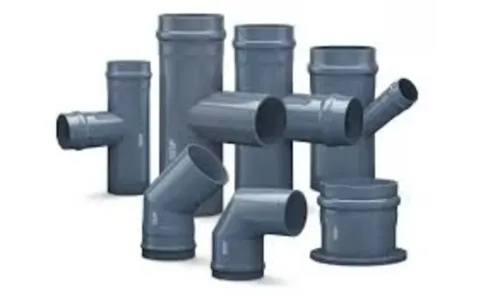
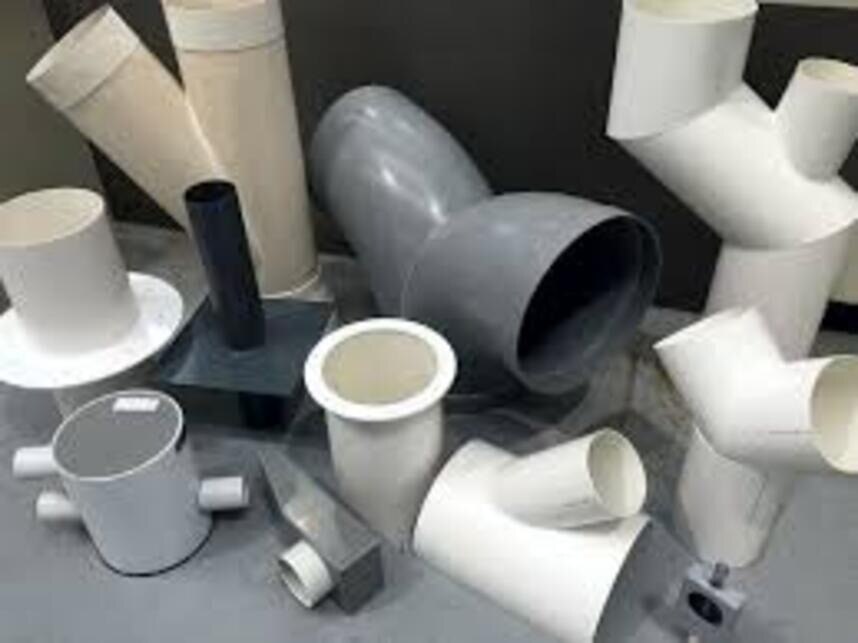
A roof outlet needs a fabricated sump or outlet body with a leaf guard, not a plain socket and elbow. Choose UV-stabilized PVC or uPVC for exposed sections, and match the outlet flange to the roof waterproofing so water cannot bypass the fitting.
| Location | Preferred form and material | Why it fits |
|---|---|---|
| Roof outlet | Fabricated UV-stabilized uPVC/PVC outlet with leaf guard and flange | Handles debris, ponding and outdoor exposure |
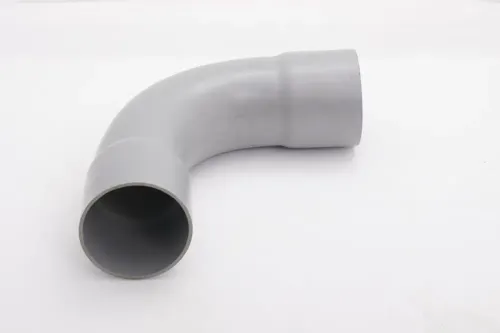
| Downpipe | uPVC or PVC long-radius 90-degree elbow and straight couplers | Reduces blockage at direction changes and withstands sun when shielded |
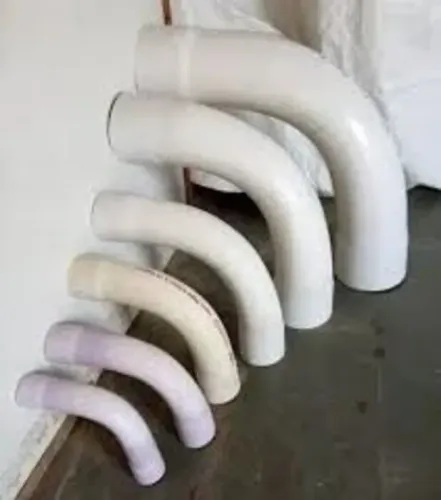
| Bend | Long-radius bend, preferably 45 degrees or a swept 90 degrees | Creates less head loss and gives leaves and grit fewer places to lodge |
| Branch | Swept branch or Y-branch in fabricated uPVC/PVC | Accepts runoff more smoothly than a sharp tee |
| Pump-discharge line | Pressure-rated fabricated uPVC/PVC bend, tee and coupler | Resists continuous or intermittent pressure; do not use a gravity SWR fitting |
For monsoon piping fittings in Nagpur, label every item as gravity drainage, intermittent surcharge or continuous pressure. A similar nominal diameter does not mean equal wall thickness, joint design or allowable pressure.
Select weather resistant PVC fittings in Nagpur only after checking the compound and the joint. UV resistance protects the PVC surface; it does not prove that a fabricated or solvent-cemented joint remains watertight outdoors.
- Reject clear or lightly pigmented PVC for permanently exposed pipework.
- Use compatible opaque coating, cladding or shielding where UV-stabilized material is unavailable.
- Provide a cleaning access point at the downpipe base and beside major direction changes.
Specify the dimensions and standards before ordering
Give the fabricator a dimensioned drawing, not only a pipe diameter. Custom PVC fittings for rainwater systems fail when the pipe fits externally but the wall thickness, joining length or branch alignment differs.
1. Record each connected pipe’s outside diameter, wall thickness, nominal size, material, and manufacturer. State whether the connection is solvent-cemented, rubber-ringed, flanged or mechanically clamped.
2. Mark the fitting type, branch angle, bend angle, centre-line radius, overall length, socket depth and insertion length. Show the required flow direction, invert level, clean-out location and minimum internal bore so a welded internal step cannot trap leaves or silt.
3. Specify the standard by service. Request pipes and drainage fittings to IS 13592 and IS 14735 for non-pressure soil, waste and rainwater work; do not use IS 4985 potable-water compliance as proof of stormwater suitability.
4. Request a fabrication drawing showing wall-thickness control, joint preparation, bead quality, branch alignment and dimensional tolerances. Ask for the PVC or uPVC compound grade, batch traceability, UV-exposure statement, and checks for impact and thermal movement.
5. If the line carries pump discharge or other pressure, state the design pressure and temperature, then require a documented pressure class and hydrostatic test for the complete fitting assembly. Also request a watertightness test record for every solvent-cemented or fabricated joint.
Swapnil Enterprises can review these measurements against a long-radius bend or swept branch before fabrication, preventing a sharp turn that restricts flow or creates a cleaning problem. Include photographs and a pipe sample when existing dimensions are uncertain.
Related products
 | Fabricated UPVC Fittings Fabricated UPVC fittings are custom-made, non-standard pipe connection components, often larger than 12 inches in diameter, constructed by joining... View product → |
 | Fabricated PVC Fittings Fabricated PVC fittings are custom-shaped fittings, often for larger diameters, made by cutting, bonding, and thermoforming segments of existing PVC... View product → |
Install exposed and buried fittings for monsoon movement and loading
Anchor the system without trapping its movement: support roof and exposed pipe runs, then give buried fittings uniform bedding and protection from point loads.
- Roof fittings: Fix outlets to the structural slab or support frame, not to a thin waterproofing layer. Seal the outlet flange with the roof waterproofing system, keep the grate removable, and leave room for thermal movement between the outlet and connected pipe. A rigid connection can crack the membrane or pull the joint apart.
- Exposed vertical stacks: Use brackets that hold the pipe body rather than tightening across a socket or fabricated branch. Add a guide near each direction change, protect the PVC from impact and prolonged sunlight, and align the stack so its weight does not hang from the roof outlet.
- Underground fittings: Place the fitting on compacted, fine-grained bedding with no stones beneath the socket or bend. Haunch both sides, compact backfill in layers, and prevent construction traffic from loading the line before adequate cover is installed. Poor support can deform PVC, alter the gradient, or open a sound-looking joint.
- Inspection points: Install an accessible chamber at the base of each downpipe and near major changes in direction. Use a cover rated for its location, keep the chamber from bearing directly on the pipe, and provide enough opening to clear leaves, silt, and roof grit.
Before backfilling, check line, gradient, joint insertion depth, and watertightness; photograph concealed fittings for future repairs.
Prevent blockage and verify every joint before heavy rain
A blocked outlet or unsealed joint can defeat a correctly sized system before peak runoff arrives. Weather-resistant PVC fittings in Nagpur need separate checks for UV exposure, impact damage, thermal movement, and joint watertightness.
1. Clear roof outlets, leaf guards, removable strainers, first-flush devices, and sediment traps. Open every accessible cleanout and remove leaves, silt, plastic, and nest material, paying special attention to the smallest branch and outlet.
2. Pour water into each roof inlet and watch the discharge at ground level. Slow flow, ponding, or overflow indicates a blockage or inadequate fall; do not wait for a storm to expose it.
3. Inspect every socket, fabricated seam, coupler, and threaded transition for gaps, cracks, whitening, or damp tracks. For solvent-welded joints, confirm that the surfaces were clean and dry, the specified primer and cement were used, and heavy rain did not reach the joint before cure.
4. Check exposed runs after hot weather for sagging, pulled sockets, loose supports, and impact marks. PVC expands about 5 × 10⁻⁵ to 8 × 10⁻⁵ m/m·°C, so supports and expansion details must let the run move without loading joints.
5. During heavy rain, keep people clear of surcharge outlets and record overflow points. Repair the cause before the next storm.
Frequently asked questions
How should you size a rainwater system for Nagpur’s monsoon?
Use the short-duration design storm intensity that matches the roof’s time of concentration, based on a local intensity-duration-frequency record or a drainage engineer’s design value.
Which PVC fitting form suits each rainwater system location?
Choose the fitting shape and PVC material according to whether the connection is exposed to sunlight and weather, buried underground, or subject to structural and traffic loads.
What details should you specify when ordering custom PVC fittings?
Provide the required diameters, wall thicknesses, connection dimensions, fitting geometry, and applicable manufacturing or piping standards.
How do you prepare monsoon piping fittings for movement and blockage?
Install exposed and buried fittings with allowance for thermal and ground movement, protect buried connections from loading, clear debris, and verify every joint before heavy rain.
Related products
 | Fabricated SWR Fittings Fabricated SWR (Soil, Waste, Rainwater) fittings are plumbing components, typically made from unplasticized polyvinyl chloride (uPVC), used in... View product → |
 | PVC FABRICATED TEE Our PVC Fabricated Tee is a high-quality, durable solution for various plumbing and construction needs. View product → |
 | PVC FABRICATED LONG ELBOW A PVC fabricated long elbow is a non-standard, custom-molded pipe fitting, often for large diameters, created by heating and bending PVC pipes rather... View product → |
 | PVC Fabricated Bend Pipe Our PVC Fabricated Bend Pipe is a high-quality, durable solution for various plumbing and construction needs. View product → |