
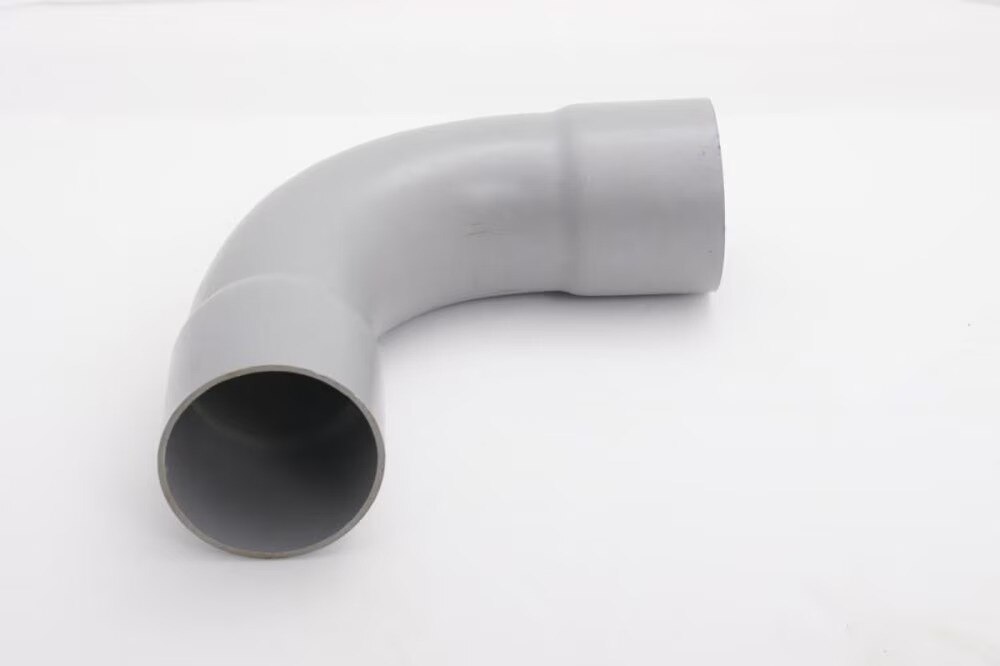
A PVC long bend can crack because installers force misaligned pipes together, move the fitting before solvent cement cures, or leave the bend unsupported in the trench. Nagpur’s heat, seasonal soil movement, outdoor storage and site impacts add stress that a correctly selected fitting can still fail to tolerate. By the end, you will be able to identify the likely failure mechanism, check an installation step by step and assess a replacement before accepting it.
Key takeaways
- Never force a misaligned pipe into the bend socket.
- Deburr, clean, lubricate, and align pipes before insertion.
- Support the bend and joints before backfilling the trench.
- Inspect cracks for stress whitening, impact marks, and manufacturing defects.
The installation stresses that crack a PVC long bend in Nagpur
Forced alignment is the main answer to why PVC long bends crack during installation in Nagpur. A long bend has a larger radius and longer lever arm than a short elbow, so slightly misaligned pipes transfer bending and torsional load into the socket shoulders and bend heel.
Pulling the pipes into line, forcing insertion, or bending the pipe to meet the fitting can start PVC long bend cracking.
Nagpur’s hot summers add movement. uPVC expands about 5–8 × 10⁻⁵ m/m·°C; a 10 m exposed run changing by 40°C can move about 20–32 mm. If both ends restrain that movement, stress concentrates at the bend. Cooling causes contraction and creates the same problem in reverse.
Check these installation stresses before blaming the fitting:
- Excessive socket insertion force can split a socket, especially when the pipe is oval, oversized, or not chamfered.
- A hammer, wrench, or dropped tool can create a gouge that becomes a crack when the pipe moves.
- Direct-sun storage heats and softens the fitting; handling or jointing it before it cools can deform the socket.
- Uneven soil, sharp stones, voids, or inadequate bedding leave the bend bridging between supports.
- Compaction, construction traffic, and backfill impact can load an unsupported bend.
- Thermal movement becomes dangerous when both connected runs are locked against movement.
A fitting can meet its specification and still fail because the installation created the stress. Inspect the crack location: a socket shoulder or heel points toward alignment or joint force, while a barrel crack demands checks for impact, point support, and buried movement.
How to assemble the bend without creating a crack
Cut and prepare every joint before applying cement; solvent welding cannot rescue a crooked assembly. This sequence prevents most PVC bend installation problems and reduces PVC long-bend cracking:
- Inspect the bend, sockets and pipe for whitening, gouges, ovality and hairline cracks. Reject damaged parts.
- Cut the pipe square, deburr the cut and chamfer the outside edge.
- Dry-fit the pipe fully without forcing it or bending the pipe into position.
- Clean and prime the surfaces when the specified joining system requires both products.
- Apply the pipe and fitting manufacturer’s specified solvent cement evenly, not excessively.
- Insert the pipe fully while the cement remains wet, using a controlled twist.
- Hold the joint still during its initial set.
Solvent cement does not correct angular or positional misalignment. Excess cement, pooled solvent, contaminated surfaces or cement used after its open time can soften the socket and create a weak region. Do not move, load, compact around or backfill a fresh joint before it has developed adequate handling strength.
| Failure or error | What goes wrong | Correct action |
|---|---|---|
| Wrong cement | PVC-U, CPVC and ABS materials can form incompatible or weak joints | Match cleaner, primer and cement to the specified pipe system |
| Forced insertion | Socket shoulders and the bend carry assembly stress | Realign or recut the pipe; never drive it into position |
| Excess cement or pooled solvent | Local softening can lead to later cracking | Apply the specified amount to clean, prepared surfaces |
| Early movement | A fresh joint can crack during handling or backfill | Follow the system’s cure instructions |
Use the specified insertion depth, temperature limits and cure time. Cure depends on size, fit, temperature, humidity and cement type, so one fixed interval is unsuitable for every Nagpur job.
How trench support and operating loads create later failure
Continuous bedding must support the bend barrel and the adjacent pipe without gaps. Remove sharp stones and hard points, compact sidefill evenly, and prevent voids that leave the fitting bridging between supports.
A bridge concentrates load at the bend or socket and can produce a PVC drainage fitting failure after burial, even when assembly looked sound.
- Place specified bedding beneath the full supported length, not only beneath each pipe end. Check the trench bottom for hollows before lowering the assembly.
- Add sidefill in controlled lifts and compact it evenly on both sides. Do not drive compaction equipment against the bend, and do not bury a fresh joint before it has adequate handling strength.
- In Nagpur black-cotton or other expansive soil, design bedding, side support, drainage and backfill for seasonal moisture movement. Poor trench drainage and differential settlement can shift a buried bend; thicker-looking PVC does not correct that movement.
Leave the specified thermal-movement allowance; locking both ends turns expansion and contraction into bend stress. Treat non-pressure drainage separately from pressure service: do not hydrostatically test the line or place a test plug against a drainage fitting unless its marking and documentation permit it.
Record whether the crack appeared before backfill, after compaction, after testing or after service began. That timeline separates assembly damage from buried or operating pvc bend installation problems.
What to verify when choosing a replacement or supplier in Nagpur
Accept a replacement only after the supplier confirms its dimensions and material system, not because it resembles the cracked fitting. Compare a pvc long bend supplier in Nagpur against the project specification and the pipe already installed.
- Nominal diameter and compatible pipe series or wall thickness
- Socket inside diameter, depth and dimensions
- Bend angle, bend radius and center-to-end dimensions
- Pressure or non-pressure drainage service
- Standard marked on the fitting or packaging, when specified by the manufacturer or project engineer, with the required BIS, ASTM or ISO documentation
- Batch traceability, solvent-cement compatibility, and storage and transport controls
| Supplier evidence | What it proves | What a photograph cannot prove |
|---|---|---|
| Dimensional drawing and pipe-series reference | The socket and center-to-end dimensions match your pipe | Interchangeability |
| Service and standard documents | The fitting suits pressure or drainage duty | Operating limits |
| Batch record and cement compatibility statement | The material and joining system are traceable | Correct solvent cement |
Reject a fitting with distorted sockets, ovality, whitening, gouges or sun damage. A catalogue photograph cannot reveal these defects, and a thicker-looking wall does not automatically prevent a pvc drainage fitting failure.
Swapnil Enterprises can be compared with other suppliers when it provides these dimensional, material-system and traceability details for the project. Choose by pipe class, service load, joint system and site conditions, including transport exposure and trench movement—not by apparent thickness alone.
Related products
 | PVC LONG BEND Our PVC Long Bend is a high-quality, durable solution for smoothly redirecting pipe flow over extended angles. View product → |
 | PVC FABRICATED LONG ELBOW A PVC fabricated long elbow is a non-standard, custom-molded pipe fitting, often for large diameters, created by heating and bending PVC pipes rather... View product → |
How to distinguish material damage from an installation error
Do not cut apart the failed bend. Preserve it, photograph the crack from several angles, and mark its position as socket, heel, crown or barrel before moving it from site.
Record these facts while they are available:
- Installation temperature and pipe alignment
- Bedding, side support and backfill condition
- Cement brand, batch and cure interval
- Insertion depth and whether the joint was forced
- Any pressure test, blocked line or test-plug event
| Pattern | What it suggests | What to check |
|---|---|---|
| Brittle white stress marks | Local overstress | Forced alignment, cold handling and excessive insertion force |
| Crack from socket heel or shoulder | Joint or alignment stress | Pipe position, insertion, movement during cure and connected-pipe strain |
| Gouge or crushed area | Tool or site impact | Handling, backfill equipment and nearby construction activity |
| Longitudinal splitting | Impact, deformation or material concern | Cold handling, ovality, buried movement and batch quality |
| Crack exactly at bonded joint | Joint preparation or curing problem | Surface cleaning, cement compatibility, cement batch and cure interval |
| Barrel crack | Support or buried-load problem | Point support, stones, voids, deformation and soil movement |
A crack at the barrel does not prove defective material, and a socket crack does not prove poor cement. This pvc drainage fitting failure may result from installation or buried movement.
Compare the fitting’s marking and batch information with the project specification before approving a replacement, and investigate pvc long bend cracking against the documented pipe class and service.
Frequently asked questions
Why do PVC long bends crack during installation in Nagpur?
Forced alignment transfers bending and torsional loads into the socket shoulders and bend heel, where cracks can begin.
How can you install a PVC long bend without cracking it?
Square-cut and deburr the pipe, clean both surfaces, use the specified lubricant, align the pipes, and push them in without hammering or twisting.
How can trench support cause later PVC bend failure?
Poor bedding, voids beneath the bend, uneven backfill, and vehicle or soil loads leave the fitting unsupported and transfer stress into the joint.
How can you distinguish material damage from an installation error?
Stress whitening, tool marks, impact dents, and cracks at the socket or heel indicate installation stress; consistent defects across multiple fittings point toward a material or manufacturing issue.
Related products
 | PVC Fabricated Bend Pipe Our PVC Fabricated Bend Pipe is a high-quality, durable solution for various plumbing and construction needs. View product → |
 | UPVC LONG BEND Our UPVC Long Bend is a premium, durable solution for smoothly redirecting pipe flow over extended angles. View product → |
 | PVC COUPLER Our PVC Coupler is a high-quality, durable solution for connecting two sections of pipe seamlessly. View product → |
 | Fabricated PVC Fittings Fabricated PVC fittings are custom-shaped fittings, often for larger diameters, made by cutting, bonding, and thermoforming segments of existing PVC... View product → |