
Choose the bend by its centre-line radius, hydraulic effect, available space, and maintenance requirements—not by the words “long” or “short” on a quotation. By the end, you will be able to match each elbow type to roof drains, stormwater headers, underground lines, and cramped chambers while checking the flow, joints, access, and monsoon risks that determine whether the system performs.
Key takeaways
- Measure centreline radius: long elbows are about 1.5D; short elbows about 1.0D.
- Use long-radius bends where space allows to reduce turbulence and blockage risk.
- Confirm pipe diameter, joining method, wall thickness and drainage slope before ordering.
- Inspect fabricated elbows for smooth interiors, accurate angles, sound joints and a traceable batch record.
Long and short elbows: compare the measured radius, not the label
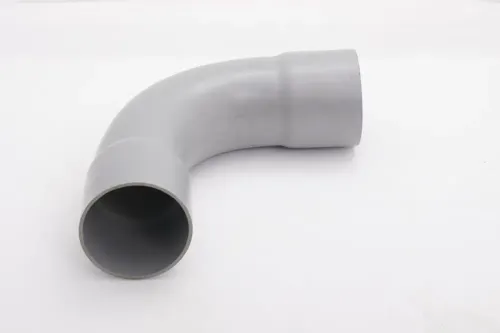
The physical difference is the centreline radius: a long-radius elbow measures about 1.5 times the nominal pipe diameter (1.5D), while a short-radius elbow measures about 1.0D. Measure from the pipe’s centreline, not from the outside wall.
| Feature | Long-radius elbow | Short-radius elbow |
|---|---|---|
| Bend geometry | Swept curve with a larger centreline radius | Tighter curve with a smaller centreline radius |
| Hydraulic effect | Smoother direction change, lower turbulence and bend loss | Sharper turn, higher local loss and turbulence |
| Debris exposure | Fewer abrupt surfaces for silt, leaves and plastic to catch | Greater blockage and rodding difficulty at the turn |
| Space required | Needs more plan length and excavation width | Fits in compact chambers and crowded connections |
The supplier’s dimensional drawing controls because “long” and “short” are not universal dimensions. Check the stated radius, bend angle, outside diameter, socket depth and spigot length before comparing products.
For long elbow versus short elbow drainage in Nagpur, monsoon rainfall alone does not decide the selection. Compare pipe diameter, available fall, expected solids, cleaning access, flow velocity and whether the line carries gravity flow or pumped pressure.
A long radius elbow in Nagpur suits a line where smoother flow and cleaning access justify the larger footprint.
A short elbow suits a constrained connection, but confirm capacity and surcharge levels when a 90-degree turn sits in a critical stormwater route; a hydraulic calculation may show that two 45-degree bends or a swept bend performs better.
Where each elbow fits in Nagpur’s monsoon drainage layout
Use long elbows on main gravity-flow routes, and reserve short elbows for space-constrained connections that remain accessible for cleaning.
| Location | Preferred elbow | When it applies |
|---|---|---|
| Roof downpipes | Long | Use at the base of a downpipe and at directional changes where leaves, silt, and roof grit enter the line. Use a short elbow only at a cramped wall or chamber connection with cleaning access. |
| Stormwater headers | Long | Choose the larger sweep for header turns, where turbulence and reduced flow area can raise surcharge during intense rain. Use a short elbow inside an accessible chamber when footprint controls the layout. |
| Underground drains | Long | Use long elbows on buried alignment changes and before long runs. A short elbow fits a compact inspection chamber, but repeated tight bends make rodding and blockage removal harder. |
| Parking areas | Short at the gully; long downstream | A compact short elbow can keep a drain inlet within the gully or kerb footprint. Use a long elbow in the buried branch or header carrying silt and litter away. |
| Surface-water collection lines | Long | Use long elbows between catch basins and collection headers to reduce abrupt flow disturbance. Use a short elbow only at a catchpit outlet or another point that can be opened and inspected. |
Nagpur’s monsoon does not dictate one radius. Specify the elbow against pipe diameter, available fall, expected solids, cleaning route, and gravity or pumped service. A long elbow usually measures about 1.5 times nominal diameter at the centreline; a short elbow is about 1.0 times.
Specify that dimension, not merely “long elbow,” when ordering monsoon drainage fittings in nagpur.
Flow capacity, bend losses, and alternatives to one tight 90-degree turn
For long elbow versus short elbow drainage in Nagpur, compare the bend’s centreline radius, not its name. A tight 90-degree elbow creates greater turbulence and local head loss than a swept bend; debris also has less room to pass when flow slows near the inside radius.
| Option | Hydraulic loss and capacity | Blockage and maintenance exposure | Practical choice |
|---|---|---|---|
| 45-degree bend | Lower loss than a 90-degree turn; preserves more flow capacity | Lower obstruction risk, but two direction changes need adequate access | Use for gradual alignment changes |
| 90-degree elbow | Highest local loss, especially with a short radius and high velocity | Tight inside radius can catch leaves, silt, and plastic; rodding is harder | Use only where footprint or connection geometry requires it |
| Swept bend | Lowest loss among these options when the radius is large and the bore stays smooth | Best passage for solids and cleaning tools; needs more space | Prefer on main headers, long downpipes, and buried drains |
| Two 45-degree fittings with a straight section | Splits the turn and reduces abrupt loss; calculate the added joint losses | Easier directional access than one tight 90, but adds joints and a possible silt-settling section | Prefer where maintenance access and a smoother turn matter |
Check the fitting manufacturer’s loss coefficient, then calculate bend loss as K v²/2g using pipe velocity v. Do not choose by angle alone: pipe diameter, slope, expected solids, and downstream capacity control performance.
A compact short elbow suits a cramped chamber or building connection. Repeating it to save fitting cost increases blockage points and cleaning effort. Keep inspection access near major changes in direction, and verify that grates, inlets, chamber benching, and discharge capacity will not overload the bend during Nagpur’s monsoon.
Compatibility and installation details that decide whether the bend works
A bend works only when its pipe, joint, foundation, and maintenance access all match. For monsoon drainage fittings in Nagpur, check the complete flow path before choosing either radius; an elbow cannot correct an undersized inlet, blocked grating, inadequate fall, or an overloaded outlet.
1. Confirm the pipe’s outside diameter, nominal size, material, wall class, and service. Match PVC to PVC drainage fittings, and verify that a pressurised line has the correct pressure-rated elbow rather than a gravity-drain fitting.
2. Dry-fit the elbow and pipe. Check socket depth, spigot length, gasket profile, solvent-cement compatibility, insertion marks, and the required bend angle. Do not force a joint into alignment; excessive angular deflection concentrates stress at the socket.
3. Prepare the trench with firm, even bedding. Support the pipe barrel continuously, pack haunching beneath both sides, remove stones and construction debris, and compact backfill in layers. A hard point under the elbow or settlement beside a chamber can crack a sound fitting.
4. Provide supports, guides, and anchors for exposed pipe. Add restraint where a pumped line changes direction; gravity drainage still needs support that prevents sagging and joint movement.
5. Confirm a rodding point, inspection chamber, or removable access near the bend. Leave working clearance around chamber connections, and bench the chamber so water does not strike a sharp ledge or trap debris.
6. Inspect line, joints, fall, and internal bore before covering. Flush out swarf, confirm the elbow has no distortion or narrowed opening, photograph connections, and record the inspection before backfilling. Once buried, a misaligned bend becomes an excavation problem.
A purchase and inspection checklist for fabricated drainage elbows
Specify the nominal diameter, outside-diameter series, bend angle, centreline radius, socket or spigot dimensions, service type, and jointing method before requesting a quote. “Long elbow” alone does not establish interchangeability.
- For a PVC fabricated long elbow in Nagpur, request the fabrication method, number and angle of mitre segments, minimum wall thickness after cutting, and dimensional inspection records.
- Check that the internal bore is continuous. Reject steps, sharp mitre lips, excess solvent cement, angular mismatch, or a reduced opening at any segment joint.
- Ask for the drawing, material grade, batch or traceability reference, measured radius, angle, end dimensions, and inspection date.
- Confirm whether the fitting is for gravity drainage or pressure service; do not substitute a pressure-rated assumption for a gravity-drainage specification.
- For buried work, document bedding, haunching, trench compaction, joint deflection, chamber connection, and protection from point loads.
| Option | What to compare | Reject or question |
|---|---|---|
| Long radius elbow in Nagpur | Centreline radius near 1.5 times nominal diameter, smooth bore, available footprint | A label without a dimensioned drawing |
| Compact short elbow | Centreline radius near 1.0 times nominal diameter, reduced space requirement | A tight bend where rodding access or solids clearance is limited |
| Either fabricated option | Angle, wall thickness, socket fit, bore, and joint method | Any mismatch with the pipe’s outside diameter or series |
Swapnil Enterprises can be asked to confirm these measurements on a fabricated fitting rather than treating the product name as proof of equivalence. Compare the supplier’s drawing with the installed pipe route, access points, fall, and expected debris load before choosing compactness over cleaning tolerance.
Related products
 | PVC FABRICATED LONG ELBOW A PVC fabricated long elbow is a non-standard, custom-molded pipe fitting, often for large diameters, created by heating and bending PVC pipes rather... View product → |
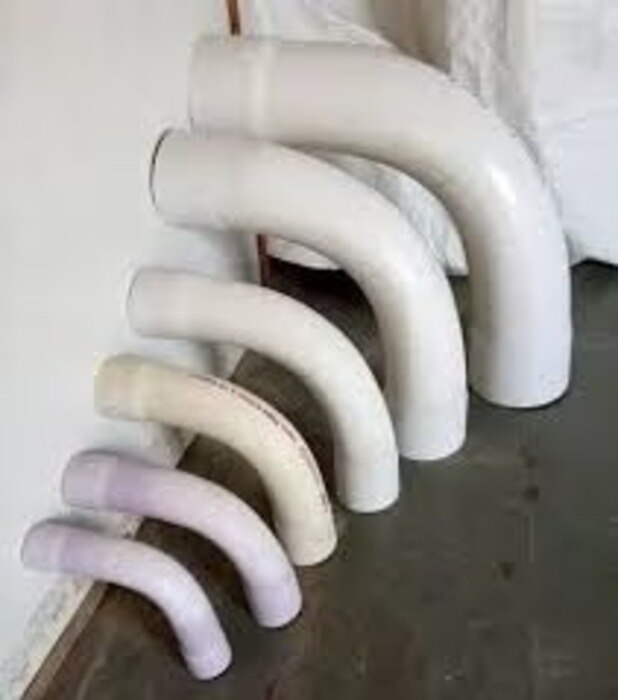
 | UPVC LONG BEND Our UPVC Long Bend is a premium, durable solution for smoothly redirecting pipe flow over extended angles. View product → |
Frequently asked questions
What is the measured difference between a long and short drainage elbow?
A long-radius elbow has a centreline radius of about 1.5 times the nominal pipe diameter, or 1.5D. A short-radius elbow measures about 1.0D. Measure from the pipe centreline, not the outside wall.
When should you use a long-radius elbow in Nagpur monsoon drainage?
Use a long-radius elbow when the layout has enough space for the larger sweep, especially on high-flow roof drains, downpipes and horizontal runs where lower bend losses and fewer blockage points matter.
What should you check before buying a fabricated drainage elbow?
Confirm nominal diameter, bend angle, centreline radius, PVC or UPVC grade, wall thickness, joining method, pressure or drainage application, dimensional tolerances and the inspection or batch documentation.
Can two tight 90-degree turns replace one short 90-degree elbow?
Two bends with a straight section between them can improve access and routing, but they add joints, length and installation work. Compare the available space, slope, cleaning access and total bend loss before choosing.
Related products
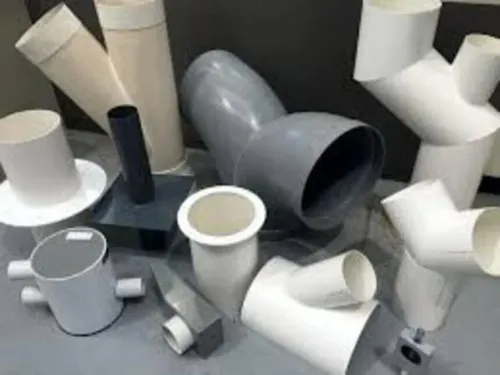
 | Fabricated SWR Fittings Fabricated SWR (Soil, Waste, Rainwater) fittings are plumbing components, typically made from unplasticized polyvinyl chloride (uPVC), used in... View product → |
 | PVC LONG BEND Our PVC Long Bend is a high-quality, durable solution for smoothly redirecting pipe flow over extended angles. View product → |
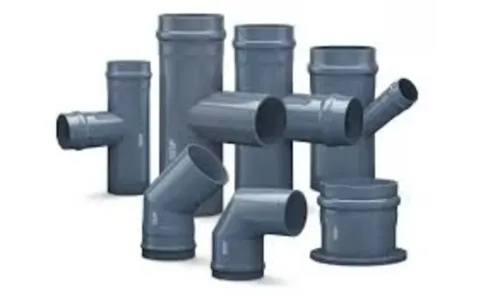
 | Fabricated UPVC Fittings Fabricated UPVC fittings are custom-made, non-standard pipe connection components, often larger than 12 inches in diameter, constructed by joining... View product → |
 | PVC Fabricated Bend Pipe Our PVC Fabricated Bend Pipe is a high-quality, durable solution for various plumbing and construction needs. View product → |