
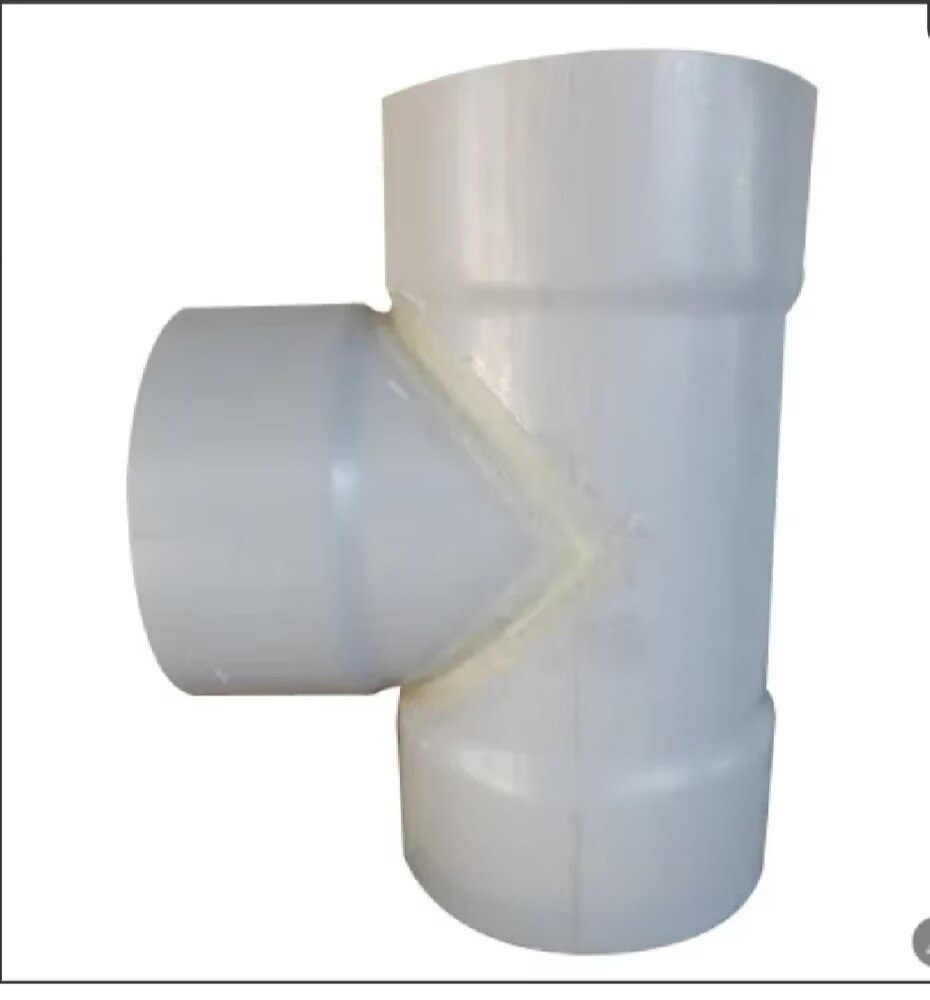
A tee that matches the nominal pipe size can still fail procurement when its outside diameter, branch geometry, socket depth, wall thickness, or pressure basis is missing. By the end, you will have a specification checklist for sizing, material selection, joining, fabrication drawings, and site acceptance on Pune projects.
Key takeaways
- State OD, pipe series, and equal or reducing configuration.
- Specify all three tee dimensions, branch angle, and joint-end type.
- Confirm PVC-U temperature, pressure, chemical, and installation limits.
- Include fabrication tolerances, drawings, support points, and inspection checks.
Specify the Tee by Dimensions, Not Nominal Size Alone
Nominal size alone cannot define flow capacity or physical fit. State whether the size refers to nominal diameter, outside diameter (OD), or the pipe-size series, then identify the tee as equal or reducing. A 110 × 110 × 63 mm tee has a 63 mm branch; it is not an equal 110 mm tee.
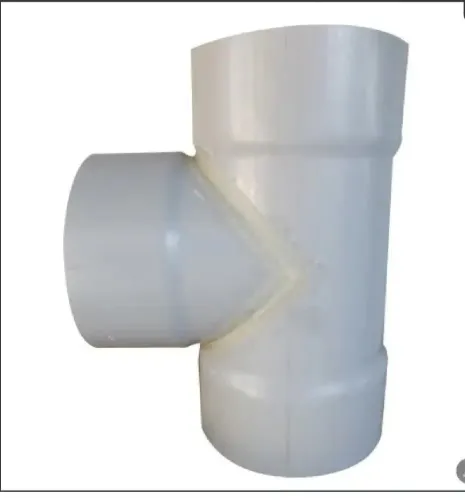
For a pvc fabricated tee size in pune, take the dimensions from the project pipe layout, the existing pipe OD, required flow, and joining system. A fabricated tee is cut and assembled from pipe or components, so its geometry may differ from an injection-molded fitting.
State these dimensions and controls on the sizing request:
- Main-run OD and branch OD, in millimetres
- Nominal diameter and pipe series, such as SDR or Schedule
- Wall thickness, SDR, or schedule for every leg
- Equal or reducing branch designation
- Branch angle and orientation, measured from the main pipe centreline
- Centre-to-end length for both run ends and the branch
- Overall length, socket depth, and insertion allowance
- End type and actual connection dimensions
- Reinforcement pad, collar, or gusset dimensions where required
- Permitted OD, wall-thickness, angle, and centre-to-end tolerances
Do not assume “standard Pune size” exists. Name the governing project standard and fabrication drawing; IS 4985 covers PVC-U pipe, not every fabricated tee. ASTM D2466 and D2467 describe molded socket fittings for Schedule 40 and 80, so use them for a custom tee only after confirming equivalent dimensions and pressure performance.
Match Branch Geometry and Joint Ends to the Pipe Layout
Choose an equal tee only when the branch pipe carries the same outside diameter and joining system as the main run. Use a reducing tee when the branch flow, available route, or connected equipment requires a smaller diameter; 110 × 110 × 63 mm is a reducing tee, not an equal tee.
| Geometry or end choice | Specify | Use when |
|---|---|---|
| Equal branch | Main diameter × main diameter × branch diameter | The branch pipe matches the main pipe |
| Reducing branch | Each outside diameter, wall thickness or SDR | The branch has lower flow demand or a smaller connection |
| 90° branch | Angle between branch and main centrelines | The route turns perpendicular to the run |
| Angled branch | Exact angle, such as 45° or 60° | The layout avoids equipment, walls, or other services |
| Socket, spigot, flange, or rubber-ring end | End type, socket depth, gasket details, and mating standard | The connection method is fixed by the installed pipe system |
Dimension centre-to-end length from the tee centreline intersection to each end face. State every main and branch length, because a fitting can match pipe diameter yet miss the available installation envelope.
For solvent-cemented ends, verify socket depth and insertion length before fabrication; shallow engagement weakens the joint, while an undersized socket prevents full insertion. Do not create an unverified socket by field cutting.
A custom pvc tee for contractors in pune should also show the branch angle and centre-to-end dimensions on its drawing. On long exposed runs, allow for PVC movement of about 0.06–0.08 mm/m·°C so rigid geometry does not load joints, supports, or connected equipment.
Choose PVC-U Material and Confirm the Service Limits
Use PVC-U (unplasticized PVC) when the connected system specifies rigid pressure pipe; do not replace it with CPVC or plasticized PVC because the diameter matches. The material certificate must identify the PVC-U resin or compound, governing standard or grade, and batch or lot number.
For anyone checking pvc tee material in pune, the tender—not Pune itself—sets the material basis. State the nominated Indian or international standard, pressure class or SDR, service temperature range, and acceptance tests.
A tee made from pressure-rated pipe is not automatically rated for the pipe’s full pressure: the fabricated branch weld or solvent-cemented joint can control assembly capacity.
| Material | Pressure and temperature basis | Chemical and compatibility check |
|---|---|---|
| PVC-U | Match the pipe’s PN, SDR, or specified pressure class after temperature derating | Confirm the fluid, concentration, exposure time, and pipe cement system |
| CPVC | Use only where the project specification names CPVC and its higher-temperature rating | Verify CPVC cement, fittings, and compatibility with the fluid |
| Plasticized PVC | Flexible material with a different pressure and temperature basis | Do not substitute for rigid PVC-U pressure or drainage service |
Set minimum and maximum operating temperatures, including cleaning or upset conditions, rather than writing “ambient.” Check the actual fluid against a chemical-resistance chart at that temperature; “PVC” alone does not establish suitability for potable water, corrosive liquids, or elevated-temperature duty.
For ASTM work, ASTM D2466 covers Schedule 40 socket fittings and ASTM D2467 covers Schedule 80. Qualify their use for a fabricated tee by confirming outside diameter, wall thickness, joint method, and pressure performance.
Write a Pune Project Purchase Drawing and Fabrication Schedule
Write “PVC fabricated tee” against a project-controlled drawing number, not “standard Pune size.” The drawing for PVC fabricated tee specifications for projects in Pune must identify the governing fitting or fabrication standard, because IS 4985 covers unplasticized PVC pipe for potable-water supply, not every fabricated tee.
Qualify ASTM D2466 or ASTM D2467 if their molded socket dimensions are used.
1. State line nominal diameter, pipe outside diameter, branch outside diameter, wall thickness or SDR/schedule, equal or reducing configuration, branch angle, centre-to-end dimensions, total lengths, socket depth, end type, and dimensional tolerances.
2. Show the pipe layout reference, flow direction, branch orientation, rotation angle, flange drilling or threaded adapter details, and the joining system. Include a sectional detail for congested routes where the branch cannot follow a standard 90-degree orientation.
3. Define PVC-U material grade, colour, pressure class or design pressure, service temperature, fluid, chemical basis, and compatibility with the connected pipe. Do not approve a tee from nominal diameter alone.
4. Require a continuous saddle or branch weld and specify reinforcement geometry where wall stress demands it. The inspection schedule must check incomplete fusion, voids, undercut, cracks, sharp internal projections, socket depth, alignment, and bore cleanliness.
5. Require batch or sheet identification, fabricator drawing revision, operator or welder record, adhesive or welding-material lot, inspection results, and pressure-test acceptance criteria. Swapnil Enterprises can use those fields to produce a traceable custom PVC tee for contractors in Pune against one released specification.
Approve no substitution without a revised drawing and written change record.
Related products
 | PVC FABRICATED TEE Our PVC Fabricated Tee is a high-quality, durable solution for various plumbing and construction needs. View product → |
 | Fabricated PVC Fittings Fabricated PVC fittings are custom-shaped fittings, often for larger diameters, made by cutting, bonding, and thermoforming segments of existing PVC... View product → |
Prepare, Join, Support, and Inspect the Tee on Site
Use the joining method specified on the purchase drawing; do not substitute a neat-looking joint for a tested one. Solvent-cemented sockets need clean, dry, chamfered mating surfaces, the specified cement and primer, full insertion, and the manufacturer’s cure time before pressure testing.
Butt fusion or hot-gas welding applies only where the PVC grade and procedure approve it.
| Connection | Site preparation and joining check | Acceptance check |
|---|---|---|
| Solvent cement | Cut square, remove burrs, dry-fit, apply cement evenly, and seat fully | No gap, movement, or visible dry area; observe cure time |
| Butt fusion or hot-gas weld | Use approved temperature, alignment, pressure, and bead procedure | Continuous uniform bead; reject scorching, voids, contamination, or misalignment |
| Flanged | Align faces without forcing the tee, fit the correct gasket, and tighten bolts in a cross-pattern | No flange distortion, gasket extrusion, or leakage during test |
| Rubber-ring | Clean and lubricate the groove and spigot; keep the ring seated and push to the insertion mark | Confirm insertion depth and allow axial movement; never cement the joint |
A site checklist for PVC fabricated tee specifications for projects in Pune should record the PVC tee material in Pune, batch identification, joining procedure, cure start and finish time, and test pressure.
- Pressure-test only after the required cure period, using the project standard and pressure class; isolate equipment that cannot withstand the test.
- Fill slowly, vent trapped air, raise pressure gradually, and inspect every branch, weld, flange, and ring joint for leakage or movement.
- Support the tee and branch independently, but do not clamp a flexible joint rigidly.
- Allow about 0.06–0.08 mm/m·°C for exposed-run expansion and contraction; verify guides, anchors, and sliding supports before commissioning.
Frequently asked questions
Why is nominal size alone insufficient for a PVC fabricated tee?
Nominal size does not identify the actual outside diameter, pipe-size series, or branch configuration. Specify the reference system and list all three dimensions, such as 110 × 110 × 63 mm.
How should contractors specify tee geometry and joint ends?
State whether the tee is equal or reducing, define the branch angle and orientation, and identify each joint end as socket, spigot, flange, or another required connection.
What PVC-U service limits should a Pune project specification confirm?
Confirm the PVC-U grade, operating temperature, pressure rating at that temperature, chemical exposure, ultraviolet exposure, and compatibility with the connected pipe system.
What should a Pune purchase drawing and fabrication schedule include?
Include dimensions, tolerances, material, joint details, branch orientation, drawing revision, quantity, delivery requirements, inspection points, and the required fabrication documents.
How should a fabricated PVC tee be installed and inspected on site?
Prepare and clean the pipe ends, use the specified joining method, align the tee without forcing it, provide support near the branch, and inspect dimensions, joints, alignment, and leaks.