
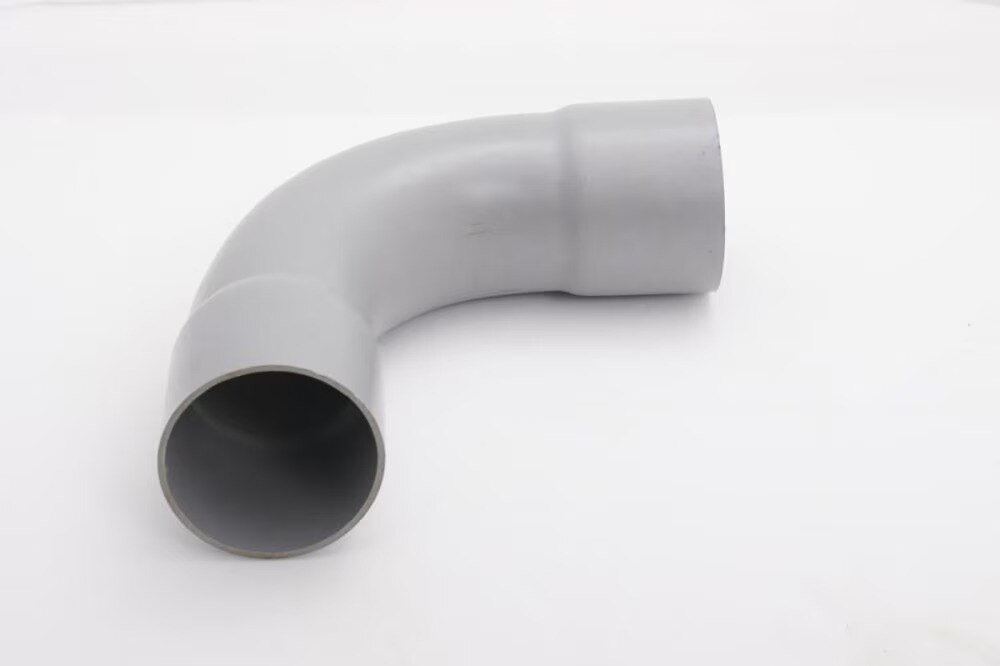
A purchase request that says only “PVC long bend, 110 mm” leaves the most important decisions unresolved: the pipe outside diameter, wall series, bend radius, socket dimensions, angle, and operating limits. By the end, you will be able to turn a nominal size into a checkable specification, compare molded and fabricated bends, and request the documents needed for an industrial installation in Pune.
Key takeaways
- State diameter, wall thickness, radius, angle, end type, and tolerances.
- Match the bend to the pipe’s outside diameter and joining method.
- Choose the radius and angle based on flow, space, and pressure needs.
- Send drawings, measurements, service conditions, and material requirements to suppliers.
What dimensions must a Pune PVC long-bend specification include?
A quotation for pvc long bend specifications in Pune needs more than “long bend, 4-inch.” State the nominal diameter, actual outside diameter, wall thickness, socket depth or spigot length, centre-to-end dimensions, centre-line radius, allowable angle, tangent length, end type, and dimensional tolerances.
- Specify the radius ratio: 3D means a centre-line radius of approximately three pipe diameters, while 5D means approximately five. Here, D is the pipe’s actual diameter, not the fitting’s outside radius. A larger centre-line radius changes the required centre-to-end dimension; calculate it from the approved drawing, not from the bend’s outer surface.
- Give the supplier a chart in this format. Use verified manufacturer or standard dimensions, never invented values.
| System | Actual outside diameter | Socket depth | Centre-to-end | Centre-line radius | Wall thickness | Angle | Tolerance |
|---|---|---|---|---|---|---|---|
| 2-inch | Verify drawing | Verify | Verify | 3D or 5D | Verify | 45°, 90°, or custom | State |
| 3-inch | Verify drawing | Verify | Verify | 3D or 5D | Verify | 45°, 90°, or custom | State |
| 110 mm | Verify metric standard | Verify | Verify | 3D or 5D | Verify | 45°, 90°, or custom | State |
| 160 mm | Verify metric standard | Verify | Verify | 3D or 5D | Verify | 45°, 90°, or custom | State |
3. Record the end type—solvent socket, plain spigot, threaded, or flanged—and the applicable standard. A 110 mm metric fitting is not automatically interchangeable with nominal 4-inch Schedule fitting. A catalogue elbow does not prove 3D or 5D geometry, so request a dimensioned drawing for any custom, fabricated, or unlisted pvc long bend size in pune.
How do you match a long bend to the existing pipe?
Match it by outside diameter and wall series, not by nominal label alone. Measure the pipe with a vernier caliper, or confirm the diameter from its marking and approved drawing. A “PVC long bend size in Pune” is incomplete without this evidence.
| Check | What to compare | What failure indicates |
|---|---|---|
| Pipe | Outside diameter and wall class, SDR, or Schedule | Similar nominal sizes can have different socket fits |
| Bend | Socket inside diameter, socket depth, spigot dimensions, and allowable insertion length | Incomplete engagement or an oversized joint |
| Connection | Solvent socket, plain spigot, threaded transition, or flange | The bend is not interchangeable with another end type |
| Documentation | Material, dimensions, pressure series, and applicable standard | Nominal-size matching has not qualified the joint |
For a PVC long bend for industrial piping in Pune, include the solvent-cement system in the purchase specification. ASTM D2466 covers Schedule 40 socket fittings; ASTM D2467 covers Schedule 80 socket fittings. IS 4985 covers unplasticized PVC pipes, not every bend, so it does not establish fitting compliance by itself.
Before solvent welding, confirm compatible pipe and fitting dimensions, clean and dry mating surfaces, and primer where the cement system requires it. Use ASTM D2564 cement where specified, then observe the manufacturer’s cure time before hydrostatic pressure testing or service.
A socket bend cannot safely replace a spigot or flanged fitting because the inch or millimetre label matches.
Which bend radius and angle suit industrial flow?
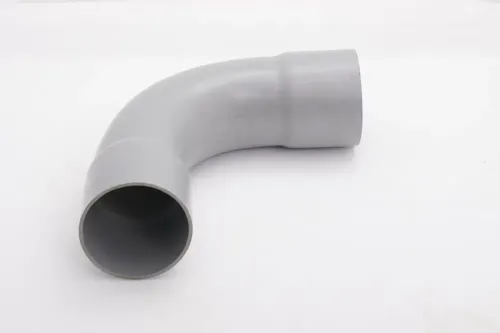
Choose a 3D or 5D bend when you need a gentler direction change than a tight elbow. D means the pipe diameter, and the ratio refers to the centre-line radius, not the fitting’s outside radius.
| Bend geometry | Centre-line radius | Flow implication |
|---|---|---|
| 3D | About 3 × D | Lower local loss and turbulence than a tight elbow |
| 5D | About 5 × D | Smoother redirection and easier cleaning-tool passage |
| Tight elbow | Short radius | Higher disturbance at the turn |
“Long bend” has no universal geometry across every PVC fitting range, so state 3D or 5D in the purchase specification. The larger radius can reduce pump load, improve solids movement, lower deposition risk at the direction change, and help cleaning tools pass when the line and access points permit it.
Total loss still depends on the actual radius, bend angle, internal bore, surface condition, and flow regime. Use a manufacturer’s loss coefficient or equivalent length in the hydraulic calculation; the word “long” is not enough.
Beyond 45° and 90°, suppliers may produce 11.25°, 22.5°, 30°, 60°, and other angles. A custom angle requires a dimensioned drawing, angle tolerance, tangent length, and approval before fabrication. PVC long bend for industrial piping in Pune should also include a thrust-restraint and support review for both above-ground and buried lines.
PVC long bend specifications in Pune that omit these checks can leave directional thrust, sag, or settlement stresses unresolved.
Should you specify PVC-U, CPVC, or another plastic?
PVC-U is the usual designation for rigid, unplasticized PVC. For a pvc long bend material in pune, require the supplier to name the exact compound rather than quoting only “PVC.”
ASTM D1784 classification, including the commonly encountered PVC-U cell classification 12454, describes compound composition and performance cells. It does not replace the fitting’s pressure rating, dimensions, temperature derating, or joint qualification.
| Material | Selection basis | Critical restriction |
|---|---|---|
| PVC-U | Standard rigid PVC service within the verified temperature and chemical range | Confirm the exact compound, pressure rating, and joint system |
| CPVC | Use when service temperature exceeds the verified PVC-U limit | Do not match to PVC-U by nominal size; dimensions, solvent systems, and pressure ratings differ |
| PP, PE, PVDF, or ABS | Consider only after a separate fluid and temperature review | Do not substitute from a catalogue label alone |
A pvc long bend for industrial piping in pune needs a datasheet stating continuous operating temperature, short-term excursion limit, pressure rating at the actual temperature, impact resistance, and compatibility with the named fluid, concentration, temperature, and exposure time. Do not publish a generic maximum temperature or pressure without the exact compound and manufacturer data.
Review acids for concentration and oxidising strength; alkalis for temperature and stress effects; oxidants for concentration and exposure duration; and solvents for swelling, softening, and cement attack. Mixed process streams require review of the combined chemistry, temperature swings, fluid specific gravity, surge, and the solvent-cement system, including ASTM D2564 cement where specified.
What should you send to a Pune supplier before approving a custom bend?
Before approving a custom bend, send a dimensioned drawing and inspection request—not only a size label such as “PVC long bend material in Pune.” Include:
1.
Pipe nominal size and measured or specified outside diameter; wall class, SDR, or Schedule; PVC-U or other material designation; bend angle; centre-line radius or 3D/5D ratio; centre-to-end dimensions; tangent length; socket depth or spigot length; end connection; wall thickness; colour; pressure rating at operating temperature; maximum continuous temperature; dimensional tolerances; solvent-cement requirement; hydrostatic or dimensional test requirement; and applicable standards.
2. Require the supplier to identify whether the bend is injection-moulded, thermoformed from pipe, fabricated from pipe segments, or assembled from standard fittings. A fabricated bend requires drawing approval showing weld or joint locations, reinforcement, ovality limits, bend smoothness, and inspection points.
3. For a buried PVC long bend for industrial piping in Pune, add burial depth, soil and traffic loads, settlement conditions, support, and thrust restraint. Pressure rating does not cover external loading or directional thrust at a change in direction.
Swapnil Enterprises can be useful when it supplies the drawing, material datasheet, joint details, and application review instead of only a catalogue label.
Attach this acceptance checklist to the purchase order:
- Approved drawing matches measured pipe OD and wall series.
- Material, colour, angle, radius, dimensions, and tolerances are stated.
- Joint method, cement, cure time, and inspection tests are accepted.
- Fabrication, buried-load, support, and thrust details are approved.
- Documents identify the applicable standard for the PVC long bend specifications in Pune.
Frequently asked questions
What dimensions must a Pune PVC long-bend specification include?
Include nominal diameter, actual outside diameter, wall thickness, socket depth or spigot length, centre-to-end dimensions, centre-line radius, allowable angle, tangent length, end type, and dimensional tolerances.
How do you match a long bend to the existing pipe?
Compare the pipe’s actual outside diameter, wall thickness, joining method, socket dimensions, and pressure requirements with the bend drawing before approval.
Which bend radius and angle suit industrial flow?
Select the centre-line radius and bend angle according to flow direction, available installation space, pressure loss, solids content, and the manufacturer’s dimensional limits.
Should you specify PVC-U, CPVC, or another plastic?
Choose the material from the fluid temperature, chemical exposure, pressure, fire requirements, and joining method; PVC-U suits different conditions from CPVC or other plastics.
What should you send to a Pune supplier before approving a custom bend?
Send a dimensioned drawing, pipe measurements, bend angle and radius, end details, service fluid, operating temperature and pressure, quantity, tolerances, and inspection requirements.