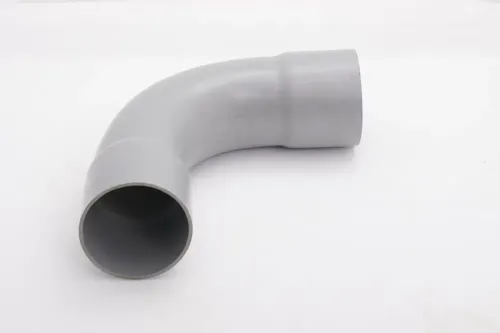

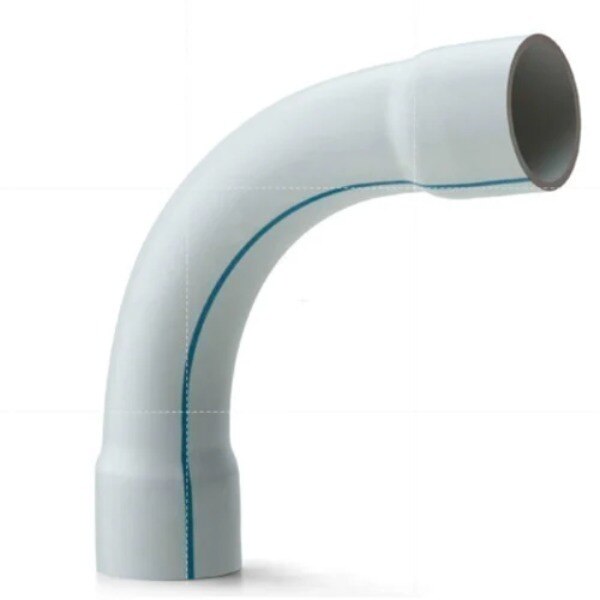
A large industrial pipe run cannot be specified safely by saying “UPVC long bend” alone. You need to match the pipe’s measured outside diameter, wall series, pressure and temperature limits, bend geometry, installation conditions, and jointing method before comparing standard and fabricated options.
Key takeaways
- Measure outside diameter and wall thickness before selecting the bend.
- Use a fabricated bend when moulded fittings cannot match the required size or radius.
- Check pressure, temperature, radius, and installation loads together.
- Request a dimensioned drawing and design basis before approving the fitting.
Start with the pipe’s actual dimensions, not its nominal size
Measure the pipe’s actual outside diameter and wall thickness before using its nominal size to select a bend. Record the nominal diameter as a reference, then match the fitting’s socket or spigot dimensions to the measured pipe standard. Nominal sizes are not interchangeable with outside diameters.
1. Record the pipe’s outside diameter, wall thickness, SDR or pressure class, and nominal size. Ask for the fitting’s dimensional standard and tolerance, not only a size label.
2. Specify the bend angle, required centreline radius, tangent lengths, and available installation space. “Long bend” does not define a radius or confirm that a 45° or 90° fitting will fit.
3. Describe the service: water, wastewater, chemical, compressed air, or another fluid. Include operating pressure, surge pressure, minimum and maximum temperature, and any chemical concentration.
4. State the jointing method—solvent cement, elastomeric ring, flanged, or another connection—and confirm compatible socket dimensions. Extra solvent cement cannot correct a socket made for a different pipe standard.
5. Explain the installation mode. For above-ground runs, provide support spacing, clamp locations, and thrust-restraint details; for buried runs, provide cover, trench width, bedding, embedment, compaction, and traffic loading.
6. Ask whether the proposed bend is moulded or fabricated. A large-diameter fabricated bend made from mitred pipe sections needs its own segment count, allowable mitre angle, fabrication procedure, and pressure rating; the straight pipe’s rating does not automatically transfer.
This information lets you judge which UPVC long bend fits large industrial pipes in Pune without approving a fitting that matches the label but not the pipe, load, or joint.
Know when a moulded bend gives way to a fabricated bend
A standard moulded long bend is the better choice when its actual outside-diameter system, wall series, angle, centreline radius, and pressure class match the pipe. Choose fabrication when stock cannot provide the required large diameter upvc bend, radius, tangent length, or joint configuration.
| Option | What to verify | When it applies |
|---|---|---|
| Moulded UPVC bend | Confirm the pipe outside diameter, wall series, angle, centreline radius, tangent lengths, and socket dimensions | Use when a standard fitting matches the pipe system without forced alignment |
| Fabricated UPVC bend | Obtain the allowable mitre angle, number of segments, weld or solvent-cement procedure, and finished pressure rating | Use for large diameters, unusual angles, extended radii, or dimensions unavailable as moulded stock |
Do not assign a fabricated bend the straight pipe’s pressure rating automatically. The manufacturer must rate the completed assembly for the stated service fluid, design pressure, and temperature.
ASTM D2466 covers socket-type Schedule 40 fittings and ASTM D2467 covers Schedule 80 fittings; these references help identify moulded products but do not approve a custom bend for chemical or pressure service.
Check that the bend uses the same metric or inch-based dimensional system as the pipe. A nominally similar Schedule 40 fitting can fail to assemble with an ISO or Indian outside-diameter system. For industrial UPVC pipe fittings, confirm the design drawing before ordering, then account for thrust restraint and support near the bend.
Compare radius, pressure, temperature, and installation loads
A long-radius UPVC bend will work only when its centreline geometry, pressure rating, temperature range, and installed restraint match the pipe run’s design basis. A generous radius can reduce head loss and turbulence, but it cannot correct an under-rated fitting or inadequate support.
The phrase “upvc long bend industrial in pune” identifies a sourcing need, not a specification. State the bend angle, centreline radius, tangent lengths, pipe outside diameter, wall thickness, SDR or pressure class, fluid, and joining method.
| Condition | What to compare | Failure if mismatched |
|---|---|---|
| Radius | Centreline radius, bend angle, and available straight length | Excessive pressure loss, poor alignment, or an unusable footprint |
| Pressure | Operating and surge pressure against the bend’s own rating | Joint leakage, deformation, or rupture; a straight pipe rating does not automatically apply to a fabricated bend |
| Temperature | Minimum and maximum fluid and ambient temperatures, including exposed-run heating | Reduced pressure capacity, softening, or thermal movement that loads joints |
| Installation loads | Weight, support spacing, pressure thrust, guides, anchors, and backfill or lifting loads | Crushed walls, joint pull-out, or movement at the bend |
For a fabricated large-diameter bend, request the allowable mitre angle, segment count, fabrication method, and test basis. Above-ground runs need supports close to the fitting without point-loading the wall; direction changes require thrust restraint. UPVC expands more than steel, so retain guides and expansion provisions rather than copying steel support spacing.
Reject the design until the supplier confirms the bend’s pressure-temperature envelope.
Verify the connection before approving the fitting
A bend is ready for approval only after a dry-fit check proves that its sockets, centreline, and supports match the installed route. A nominally matching size can fail at the joint when the pipe uses a metric ISO or Indian outside-diameter system and the fitting uses inch-based Schedule 40 or Schedule 80 dimensions.
1. Measure the bend socket’s actual inside diameter and insertion depth against the pipe’s outside diameter, wall series, and pressure class. Reject a joint that is loose, cannot reach its insertion mark, or requires force to assemble.
2. Confirm the angle, centreline radius, tangent lengths, and socket orientation on the layout drawing. Rotate the bend into position without twisting the pipe or creating a gap at the next connection.
3. Check the specified joining method. Solvent-cemented industrial UPVC pipe fittings need compatible socket dimensions, clean and dry surfaces, suitable primer or cement where specified, and the stated cure time. Extra cement cannot correct a mismatched standard.
4. Verify thrust restraint at the direction change before installation. Pressure thrust acts against the bend, so calculate the restraint or anchorage and place supports near an above-ground fitting without creating point loads or crushing the pipe wall.
5. Complete the required pressure test only after the joint has cured, then inspect for seepage, movement, and support deflection. Keep the bend’s material designation and test basis on file; ASTM D1784 identifies rigid PVC compound properties that a generic “PVC” description does not establish.
Request a drawing and design basis from the Pune supplier
A quotation that says “UPVC long bend, 90°” is not a design basis. Ask the industrial piping supplier in Pune for a signed, dimensioned drawing tied to your pipe’s actual outside diameter, wall thickness, SDR or pressure class, bend angle, centreline radius, tangent lengths, and jointing method.
Request these documents before approval:
- Material certificate identifying the unplasticized PVC compound, its designation, and test basis; ASTM D1784 classification is a useful reference.
- Pressure certificate stating the rating at the quoted design temperature and the derating method. Reject a single pressure number with no temperature limit.
- Socket drawing showing insertion depth, bore, interference, and the pipe standard it matches.
- Batch or lot traceability linking the fitting to production records.
- Hydrostatic or leak-test procedure, including test pressure, duration, and acceptance criteria.
- Chemical-compatibility statement for the conveyed liquid and concentration.
- Installation sheet covering solvent cement, primer, cure time, supports, and thrust restraint.
Assess Swapnil Enterprises by whether its quotation supplies these engineering records for the proposed moulded or fabricated bend, not by the word “custom.” A fabricated bend also needs segment geometry, joint details, and inspection records. Missing drawings, mismatched socket dimensions, or clamps that impose point loads disqualify a nominally compatible fitting.
Related products
 | UPVC LONG BEND Our UPVC Long Bend is a premium, durable solution for smoothly redirecting pipe flow over extended angles. View product → |
 | Fabricated UPVC Fittings Fabricated UPVC fittings are custom-made, non-standard pipe connection components, often larger than 12 inches in diameter, constructed by joining... View product → |
Frequently asked questions
How do you select a UPVC long bend for a large industrial pipe?
Measure the pipe’s actual outside diameter and wall thickness, record the nominal size, and match the bend’s socket or spigot dimensions to the pipe standard.
When should you use a fabricated UPVC bend instead of a moulded bend?
Use a fabricated bend when the required diameter, bend radius, angle, or installation geometry is not available as a moulded fitting.
What should you compare before approving a large-diameter UPVC bend?
Compare bend radius, pressure rating, operating temperature, pipe dimensions, support conditions, thermal movement, and installation loads.
What documents should a Pune supplier provide for an industrial UPVC bend?
Request a dimensioned drawing showing diameter, wall thickness, socket or spigot details, bend radius, angle, tolerances, and the design basis used for selection.